

Ayush Bagwari
Hi, I'm the CEO & Founder of Outreach Empress. I help brands and SEO agencies get better organic rankings with our link building services.
Those days are gone when SaaS link building used to be about volume. It’s 2025, and with th rise of AEO and GEO, SaaS link building is now more about building a result-oriented strategy, and placing links contextually. After 7 years building links for SaaS companies, I’ve watched several ups-and-downs in the SaaS niche. Recently, I’ve noticed that If your goal is to build a strong authority, digital PR is better than guest posting for SaaS. Here are 10 SaaS link building trends shaping 2025, based on what’s actually working.
Top SaaS Link Building Trends in 2025
1. AI-Powered Competitor Gap Analysis
Isn’t it sound magical? You can finish the days of work in just few minutes with AI. Here’s my exact process to do a complete AI powered competitor gap analysis:
- Export your top 3 competitors into Ahrefs “Link Intersect” tool.
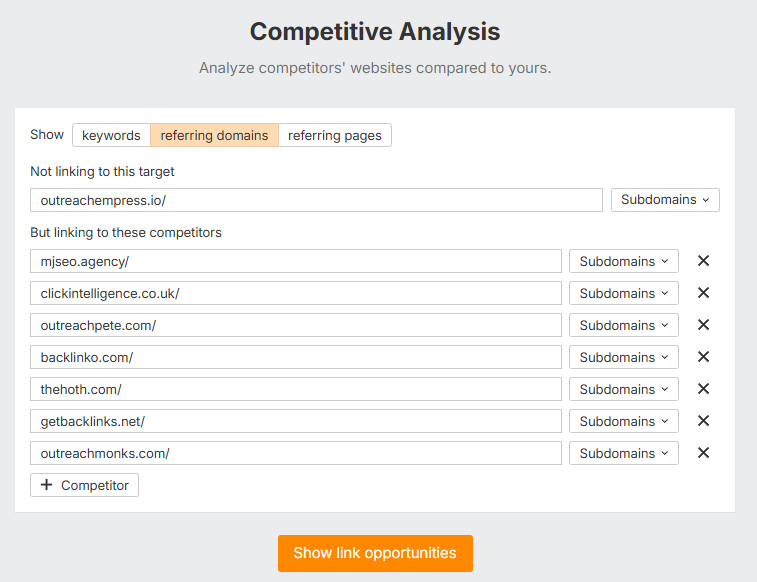
- Filter for DR 40+ sites linking to all 3 competitors but not you.
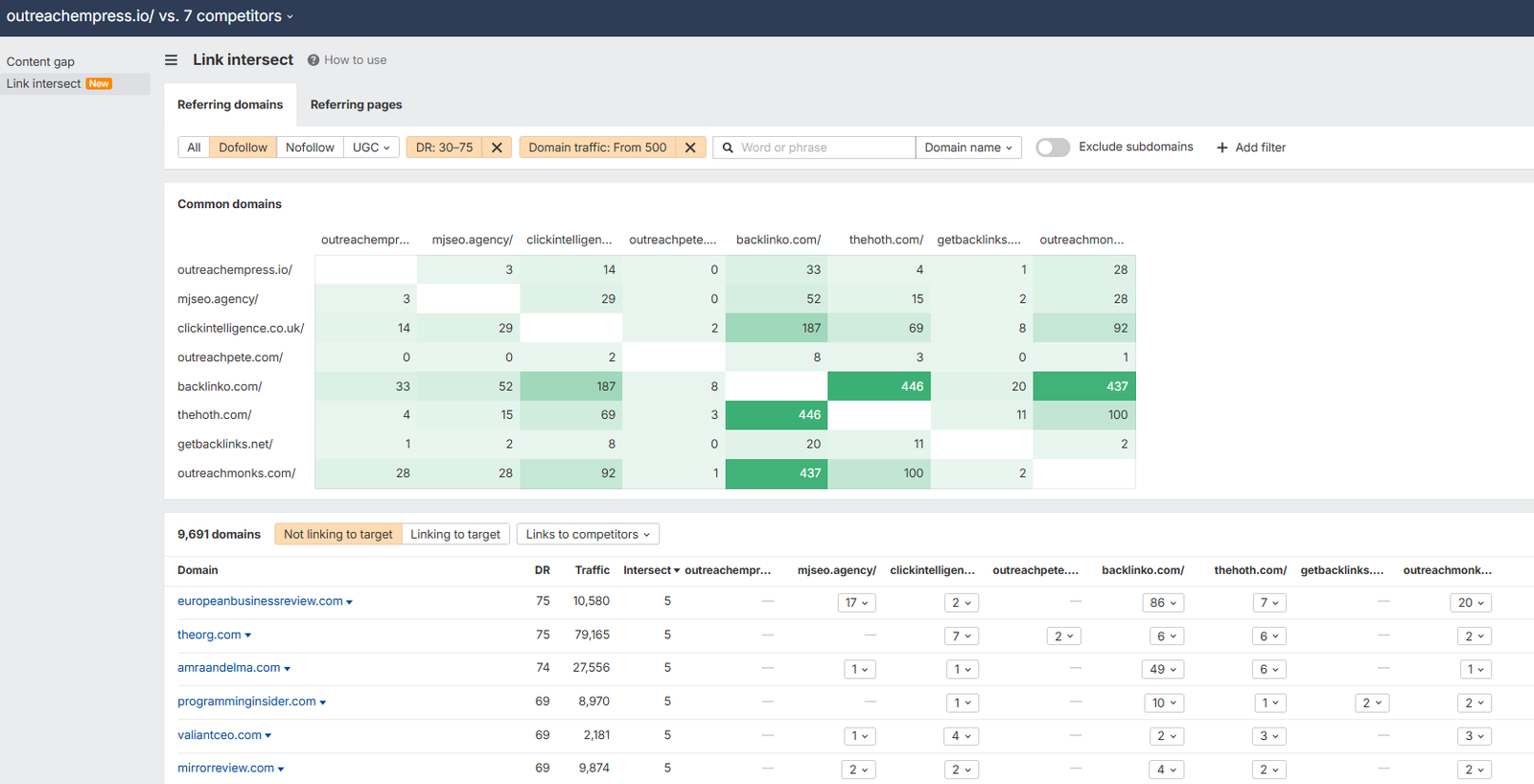
- Use Jasper or ChatGPT with this prompt:
“Analyze [target site URL] and write a personalized pitch explaining why our [specific feature] would interest their audience based on their recent posts“ - Send 10-15 personalized emails per day (not 100 generic ones)
The AI personalizes each email based on what the site actually covers. Cold outreach typically converts at 8.5%, but AI-personalized emails in my campaigns hit 18-23% response rates. Just do remember that people have become much smarter than they used to be. Everyone understand the language of AI so make sure to sound like a human not like a tool.
Tools I Use:
- Ahrefs
- ChatGPT and Jasper
- Lemlist for automated follow-ups
Real Example:
I ran competitor analysis for a project management SaaS. Found 23 productivity blogs linking to Asana, Monday, and Trello but not my client. Use my AI-personalized outreach system, and earned 15 SaaS backlinks in just 2 weeks.
2. Original Data Content (Not Generic Blog Posts)
If you’re still posting boring and generic how-to posts articles, you need to accept the truth that these kinda articles don’t earn links anymore. If you want links naturally, you need to spend time on research, and focus on preparing real, and relevant content.
Articles with 3000+ words get 3.5 times more backlinks than shorter articles, but length alone isn’t enough, you need unique data.
What Actually Works?
| Content Type | Backlink Potential | Time Investment |
|---|---|---|
| Industry surveys | High (20-50 links) | 6-8 weeks |
| Original case studies | Medium (5-15 links) | 2-3 weeks |
| Data analysis reports | High (15-40 links) | 4-6 weeks |
| Generic listicles | Low (0-2 links) | 1 week |
My Process for Creating Original Content
- Run quarterly surveys using Typeform (100+ responses minimum)
- Analyze results and find 3-4 surprising insights
- Create visualizations in Tableau or Canva
- Write a detailed report with methodology section
- Pitch findings to industry publications
- I also use Chatgpt, Claude, Surfer, and Jasper to make sure I don;t publish reptetive content.
Real Example:
A SaaS client published salary benchmarks for their industry. It earned 47 backlinks in 3 months because sites kept citing the data. We spent $200 on survey incentives and 3 weeks on analysis.
Skip: Generic listicles, “ultimate guides” with no original insights
Focus on: Original research, proprietary data, detailed case studies with metrics.
3. Digital PR Replaces Traditional Guest Posting
48.6% of SEOs now rate digital PR as the most effective link-building tactic in 2025. Why? One feature in TechCrunch beats 50 guest posts on niche blogs.
Agencies now allocate 32.1% of their overall SEO budget to link building, with digital PR taking the largest share.
What Actual Digital PR means?
- Creating newsworthy stories journalists want to cover
- Pitching data to reporters actively writing stories
- Getting quoted as an expert in industry publications
How I Approach It?
- Create original research (survey, data analysis, trend report)
- Write a compelling press release focusing on the surprising finding
- Pitch to journalists who cover your industry (I use Muck Rack to find them)
- Follow up when they’re writing related stories (set Google Alerts for your keywords)
- I also recommend using tools like Olivia Brown and HOAR for better results.
Response Rate Comparison:
| Outreach Method | Response Rate | Avg. Domain Authority |
|---|---|---|
| Cold guest post pitch | 3-5% | DR 20-40 |
| Digital PR pitch | 12-18% | DR 60-85 |
| HARO responses | 15-25% | DR 50-90 |
Real Impact:
A single feature in Business Insider drove more referral traffic than 6 months of guest posting—plus the backlink has higher authority (DR 92 vs. average DR 35 from guest posts).
Tools I Use:
- Muck Rack (journalist database)
- Google Alerts (track relevant stories)
- Prowly or Cision (PR distribution)
- Olivia Brown
4. Hyper-Niche Placement Over Generic Directories
Generic backlinks lost value with time. 84.6% of SEO experts now rely on domain relevancy rathar than domain authority while selecting backlinks.
Target Sites:
- SaaS-specific directories (G2, Capterra, Software Advice)
- SaaS Relevant sites ranking for your targeted keywords
- Industry forums and communities
- Product comparison sites
- Niche newsletters and podcasts
My Vetting Process:
| Criteria | Minimum Threshold | Why It Matters |
|---|---|---|
| Domain Relevancy | Same industry/niche | Google ranks relevance high |
| Organic Traffic | 1,000+ monthly visits | Proves site quality |
| Domain Rating | 30+ DR | Authority signal |
| Link Profile | Natural anchor text distribution | Avoids spammy sites |
Real Example:
Instead of chasing links from general “business” blogs, I focused on 15 HR tech publications for an HR SaaS client. Result: 12 backlinks from DR 40-65 sites, 300% increase in qualified demo requests.
Skip: Generic business directories, paid link farms, irrelevant high-DR sites
Focus on: Industry-specific platforms, competitor backlink sources, niche communities
5. HARO Alternatives (Since HARO Shut Down)
HARO closed in 2024, but journalist query platforms still work. I respond to 3-5 queries daily.
Platforms I Use:
| Platform | Cost | Response Time | Success Rate |
|---|---|---|---|
| Featured | Free | 24-48 hours | 20-30% |
| Qwoted | $49/month | 12-24 hours | 15-25% |
| Terkel | Free | 48 hours | 25-35% |
| Connectively (new HARO) | Free | 24-48 hours | 18-28% |
My Response Strategy:
- Check queries every morning (8-9 AM)
- Only respond if I have genuine expertise
- Provide 3-4 specific points, not generic fluff
- Include credentials and link to relevant case study
- Follow up once if no response in 72 hours
Real Win: Responded to a Forbes contributor’s query about SaaS pricing models. Got quoted with a backlink (DR 94). Took 15 minutes to write a 200-word response.
Pro Tip: Journalists want specific examples, not theories. Share actual numbers from your experience.
6. Strategic Partnership Link Exchanges
Not the spammy “link exchange” from 2010. This is about genuine co-marketing with complementary SaaS tools.
Partnership Types That Work:
| Partnership Type | Link Opportunities | Effort Level |
|---|---|---|
| Integration pages | 2-4 links | Medium |
| Co-hosted webinars | 1-2 links | High |
| Joint case studies | 2-3 links | Medium |
| Co-created content | 3-5 links | High |
My Process:
- Identify non-competing SaaS tools your customers also use
- Reach out proposing mutual integration or content partnership
- Create genuinely useful resources (not just promotional)
- Both companies promote and link to the resource
Real Example: Partnered with a CRM tool (we were a customer support SaaS). Created “The Complete Customer Success Tech Stack” guide together. Each company linked from integration pages and blog posts. Total: 6 backlinks between both sites.
Skip: Random link exchanges with irrelevant sites
Focus on: Tools your customers actually use, complementary (not competing) products
7. Podcast and Video SEO Backlinks
Video accounts for 80% of all internet traffic. Podcasts and YouTube are underutilized for link building.
Where Links Come From:
- Podcast show notes (every episode links to guests)
- YouTube video descriptions
- Podcast transcripts published as blog posts
- Guest resource pages
My Approach:
- Target podcasts with 1,000+ downloads per episode
- Check if they publish show notes with links (most do)
- Pitch specific topics I can provide value on (not just “interview me”)
- Prepare 3-4 concrete takeaways with examples
Podcast Outreach Template:
Subject: [Specific Topic] for [Podcast Name]
Hi [Host],
I’ve been listening to [Podcast Name] for [time period], especially enjoyed your episode on [specific episode].
I’d love to share insights on [specific topic] based on [your unique experience/data]. Specifically:
– [Concrete point 1]
– [Concrete point 2]
– [Concrete point 3]
Here’s a recent article I wrote on this: [link]
Would this fit your audience?
[Your name]
Real Stats: I’ve appeared on 12 SaaS podcasts in the last year. Each episode linked to our site from show notes. Average DR: 42. Zero cost except 1 hour per interview.
8. Converting Unlinked Brand Mentions
55% of all indexed pages have zero referring domains. Many sites mention your brand without linking—easy wins.
Tools for Finding Mentions:
- Google Alerts (free, basic)
- Ahrefs Content Explorer ($99+/month, advanced)
- Brand24 ($49+/month, real-time)
- Mention ($25+/month)
My Weekly Process:
- Check Ahrefs for new unlinked mentions (Monday mornings)
- Verify the mention exists and is positive
- Send polite outreach requesting a link
- Follow up once after 5 days
Outreach Template:
Subject: Thanks for mentioning [Your Company]!
Hi [Name],
I noticed you mentioned [Your Company] in your recent article "[Title]" — thanks for the shoutout!
I noticed the mention isn’t linked. Would you mind adding a link to [specific relevant page]?
It would help readers learn more about [specific benefit].
Either way, thanks for covering [topic]!
[Your name]
Success Rate: 40-50% add the link. Takes 5 minutes per outreach.
Real Example: Found 8 unlinked mentions from a case study we published. Sent outreach, got 5 backlinks added within 2 weeks. All were DR 30-55 sites.
9. E-E-A-T Focused Authority Building
94% of link builders say quality matters more than quantity. Google’s focus on Experience, Expertise, Authoritativeness, and Trustworthiness (E-E-A-T) changed everything.
Site Quality Checklist Before Outreach:
| Factor | Green Flag | Red Flag |
|---|---|---|
| Domain Age | 2+ years | Less than 6 months |
| Content Quality | Original, researched | Thin, AI-generated |
| Author Credentials | Named authors with bios | Anonymous posts |
| Traffic Pattern | Steady/growing | Sudden spikes/drops |
| Link Profile | Natural, diverse | Spammy, exact match anchors |
My Prioritization:
- .edu and .gov sites (if relevant)
- Established industry publications (5+ years old)
- Sites with named expert authors
- Companies with real physical addresses and teams
Real Impact: Focused on 30 high-authority targets (DR 60+) instead of 200 low-quality sites. Took 3 months to secure 8 backlinks, but organic traffic increased 47% in 6 months.
Skip: PBNs, link farms, sites with thin content
Focus on: Established publications, expert-written content, transparent site ownership
10. LinkedIn for B2B SaaS Outreach
17.3% of SEOs now use LinkedIn for link building, especially in B2B and SaaS. Response rates beat cold email.
Why LinkedIn Works:
- Build relationship before pitching
- See mutual connections
- Higher trust than cold email
- Can view content they engage with
My LinkedIn Outreach Process:
| Step | Action | Timeline |
|---|---|---|
| 1 | Find target (editor, blogger, founder) | Day 1 |
| 2 | Send personalized connection request | Day 1 |
| 3 | Engage with their content (like, comment) | Days 2-7 |
| 4 | Send DM with collaboration idea | Day 8-10 |
| 5 | Follow up if no response | Day 15 |
Connection Request Template:
Hi [Name], I've been following your work on [specific topic] at [Company]. Would love to connect and exchange ideas on [relevant topic].

[Your name]
Pitch Template (After Connection):
Hi [Name],
Loved your recent post about [specific topic].
I’m working on [relevant resource] that covers [specific angle].
Thought it might interest your audience at [their site] given your focus on [their content theme].
Would you be open to checking it out?
No pressure if it's not a fit.
[Your name]
Real Stats: LinkedIn outreach gets 30-40% response rate vs. 8-12% for cold email. Takes longer to build relationship, but higher conversion.
SaaS Link Building Trends: Performance Benchmarks
Here’s what effective link building looks like in 2025:
| Metric | Poor Performance | Good Performance | Excellent Performance |
|---|---|---|---|
| Avg. Domain Rating | Below 20 | 30-50 | 50+ |
| Links per month | 1-3 | 5-10 | 15+ |
| Referral traffic per link | 0-10 visits | 50-100 visits | 200+ visits |
| Cost per link | $500+ | $100-300 | $0-100 |
| Content to link ratio | 10:1 | 5:1 | 3:1 |
Budget Allocation (Based on Agency Data):
Agencies allocate 32.1% of their SEO budget to link building. Here’s how to split it:
| Tactic | Budget % | Expected Results |
|---|---|---|
| Digital PR | 35% | 5-10 high-DR links |
| Original content creation | 30% | 10-20 organic links |
| Tool subscriptions | 15% | Ongoing opportunities |
| Partnership outreach | 10% | 3-5 strategic links |
| HARO/journalist platforms | 10% | 5-8 media links |
Conclusion
Link building in 2025 rewards strategy over volume. Focus on digital PR, original data, and strategic partnerships instead of mass outreach. The SaaS companies winning in search aren’t building the most links—they’re building the right ones.
Start with one approach: Create original research, pitch it to 10 relevant journalists, and track results. That single campaign will teach you more than 100 generic guest posts.
91.89% of your competitors are likely buying links. Don’t compete on their terms. Build links through genuine value, and you’ll win in the long run.