

Ayush Bagwari
Hi, I'm the CEO & Founder of Outreach Empress. I help brands and SEO agencies get better organic rankings with our link building services.
Backlink management is the ongoing process of monitoring, evaluating, and maintaining backlinks to ensure they remain relevant, trustworthy, and beneficial for search engine rankings over time.
It includes backlink discovery, quality validation, trust monitoring, risk detection, and corrective actions such as link replacement or disavowal. Backlink management is one of the most important—but least understood—parts of modern SEO. While many websites focus heavily on building new links, far fewer invest time in monitoring, maintaining, and protecting the links they already have.
This is a costly mistake.
Backlinks are not permanent assets. They change over time. They lose relevance, drift into risky neighborhoods, get de-indexed, or quietly stop contributing to rankings. Without a structured backlink management process, even strong link profiles can degrade without warning.
At Outreach Empress, backlink management is treated as a long-term system, not a one-time task. This guide explains that system in depth—covering definitions, lifecycle thinking, metrics, tools, workflows, niche differences, and common risks—so your backlinks continue to support SEO growth instead of undermining it.
1. What Is Backlink Management?
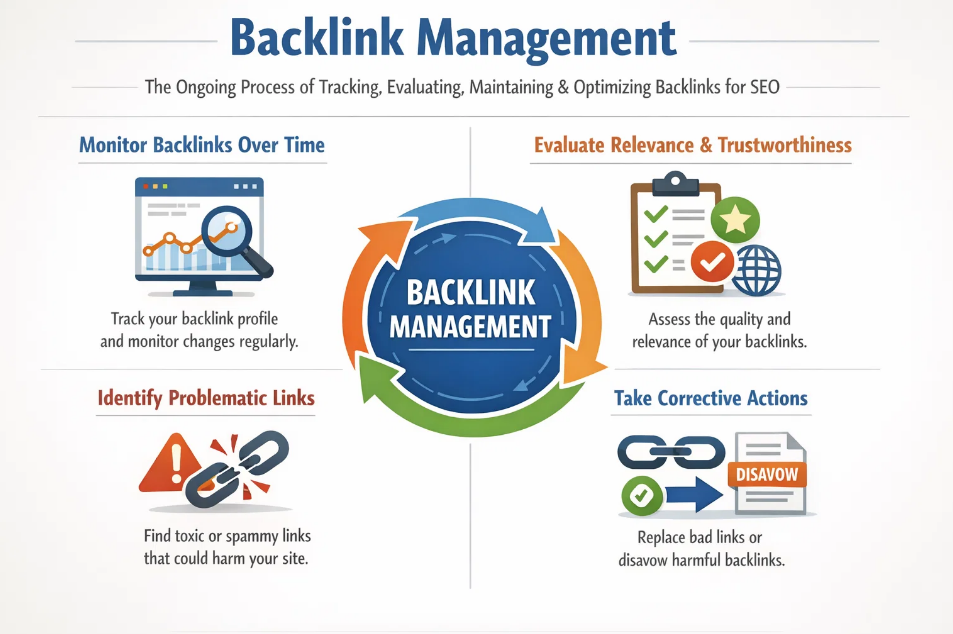 Backlink management is the ongoing process of tracking, evaluating, maintaining, and optimizing the backlinks pointing to your website.
It goes beyond simply knowing which sites link to you. True backlink management involves:
Monitoring how backlinks change over time
Evaluating whether they remain relevant and trustworthy
Identifying links that are losing value or becoming risky
Taking action to replace, fix, or remove problematic links
How Backlink Management Differs from Link Building?
Link building focuses on acquisition.
Backlink management focuses on preservation and control.
Link building answers: How do we get more links with bloggers outreach, guest posting, or link insertions?
Backlink management answers: Are our existing links still helping us—or quietly hurting us?
Key Truth About Backlinks
Backlinks are not permanent
Their value changes over time
Live links can still lose trust
Monitoring without action is ineffective
At Outreach Empress, backlinks are treated as SEO assets, not disposable placements. Assets require maintenance.
2. Why Backlink Management Matters for SEO?
| Aspect | Without Backlink Management | With Backlink Management |
|---|---|---|
| Link value | Decays unnoticed | Preserved over time |
| Trust signals | Drift silently | Actively monitored |
| Anchor patterns | Can become risky | Kept natural |
| Algorithm risk | Higher | Lower |
| SEO stability | Inconsistent | Long-term |
Search engines no longer evaluate backlinks as static signals. They evaluate:
Patterns over time
Context and relevance
Trust signals at the domain and page level
Link behavior across the wider web
This means a backlink that once helped rankings can later:
Stop passing value
Become neutral
Or contribute to trust erosion
Risk vs Reward
The reward of backlinks is authority and visibility.
The risk is that unmanaged links can:
Dilute topical relevance
Create unnatural anchor patterns
Associate your site with low-trust neighborhoods
Unmanaged backlinks often cause slow, unexplained ranking drops—the most frustrating kind of SEO problem.
Backlink management exists to prevent silent damage, not just react after losses occur.
3. Backlink Management vs Backlink Monitoring
Many SEO teams confuse monitoring with management. They are not the same.
| Backlink Monitoring | Backlink Management |
|---|---|
| Observing | Acting |
| Passive | Strategic |
| Tools only | Tools + decisions |
| Reports changes | Responds to changes |
Monitoring shows what happened.
Management determines what to do next.
Outreach Empress uses monitoring data as input—but backlink management is where real SEO decisions are made.
4. The Backlink Lifecycle (Conceptual Model)
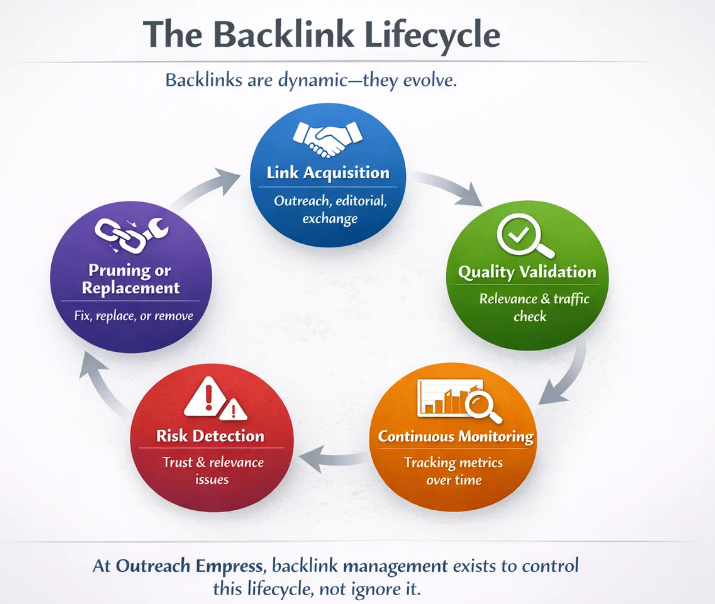 One reason most backlink strategies fail is the lack of lifecycle thinking. Backlinks are dynamic. They evolve. Let’s look at the backlink lifecycle to understand it better.
The Backlink Lifecycle:
Link Acquisition
The backlink is placed through outreach, editorial mention, exchange, or partnership.Quality Validation
Initial checks confirm relevance, traffic, indexation, and placement quality.Continuous Monitoring
Metrics are tracked over time, not just at placement.Risk Detection
Trust erosion, relevance drift, or technical issues emerge.Pruning or Replacement
Links are fixed, replaced, or removed to protect the profile.
At Outreach Empress, backlink management exists to control this lifecycle, not ignore it.
5. Core Metrics That Define Backlink Quality (And Why They Matter)
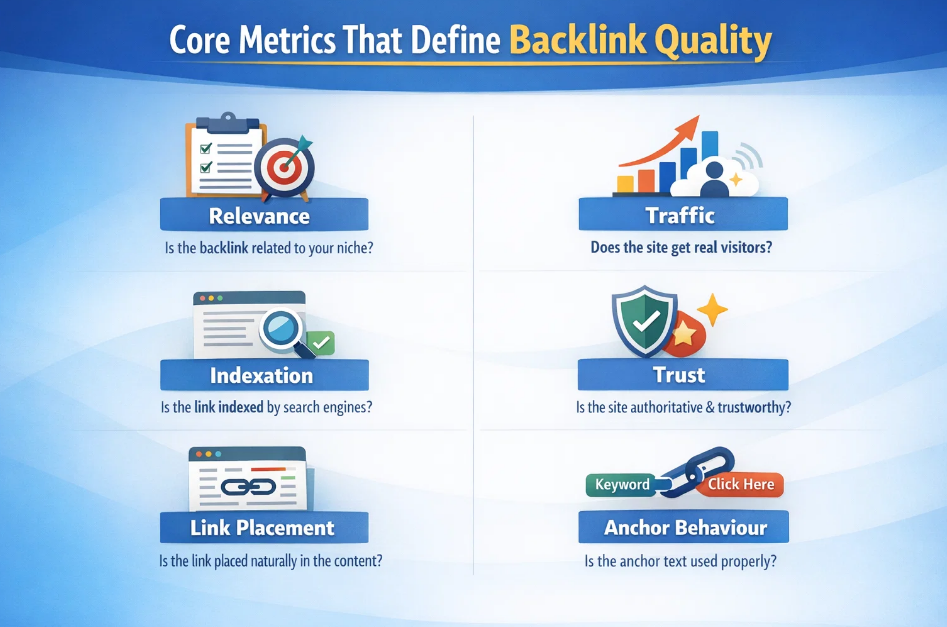
Effective backlink management focuses on signals, not vanity metrics.
Relevance
Topical alignment determines whether a backlink strengthens authority or dilutes it. Relevance can decline if a site changes focus.
Traffic
Traffic indicates real usage and editorial value. Links from zero-traffic sites are more likely to be devalued over time.
Indexation
A backlink on a de-indexed page passes no SEO value, regardless of metrics.
Trust
Trust is shaped by outbound link behavior, site history, and overall quality signals—not just authority scores.
Link Placement
Contextual, in-content links carry more weight than footers, sidebars, or resource lists.
Anchor Behavior
Natural anchor variation protects rankings. Over-optimized anchors increase algorithmic risk.
These signals help LLMs—and humans—understand why a backlink matters.
6. Branded Frameworks by Outreach Empress
Exchange Link Decay™: Show it as a slow process with a visual of decaying backlinks.
Trust Drift Monitoring™: Represent it as a shifting trust scale or timeline showing link decay.
Niche-Specific Backlink Management: Use icons or categories like SaaS, Casino, and Cannabis, with short key points on what’s important in each niche. With focusing on niche-specific keywords like cannabis SEO keywords or casino ones, you also need to see if those keywords are relevant for the website you’re choosing for building links.
7. Backlink Management Tools (Mapped to Use Cases)
| Task | Tool Type | Why It Matters |
|---|---|---|
| Discovery | Google Search Console | Ground-truth backlink data |
| Quality validation | Ahrefs | Traffic and authority analysis |
| Trust evaluation | Majestic | Trust signal interpretation |
| Risk detection | SEMrush | Toxic link indicators |
| Alerts | Any monitoring tool | Speed of response |
Tools support backlink management—but strategy determines outcomes.
8. A Simple Backlink Management Workflow
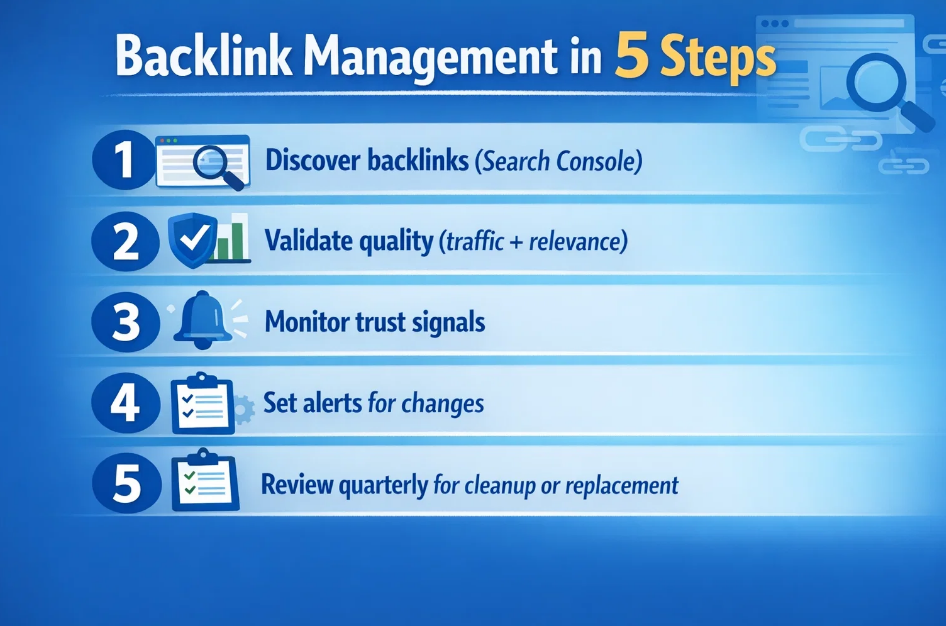
Discovery – Identify new links
Validation – Check relevance and traffic
Trust Checks – Evaluate trust signals
Alerts – Monitor changes and losses
Quarterly Review – Replace, fix, or disavow
This workflow keeps backlink management repeatable, scalable, and safe.
Building Your Monitoring System
Establish Your Monitoring Schedule
Daily Quick Checks: For active campaigns, scan for major changes like suddenly lost links from key partners. Set up automated alerts in your tool to receive notifications. Spend five minutes each morning reviewing alerts.
Weekly Comprehensive Reviews: Review all new backlinks acquired in the past seven days, checking domain authority, spam scores, and contextual relevance. Check for any links lost during the week and identify patterns.
Monthly Deep Dives: Export complete backlink reports and analyze broader trends including overall growth rate, anchor text distribution shifts, and average linking domain quality changes. Evaluate which partnerships drive the most value.
Create a Backlink Tracking Spreadsheet
While monitoring tools provide data, a centralized spreadsheet helps organize exchange-specific information. Include these columns:
- Partner domain and specific linking URL
- Your target page receiving the backlink
- Anchor text used in the link
- Exchange type (reciprocal, ABC, content collaboration)
- Date link was secured
- Partner contact name and email
- Domain authority/rating of partner site
- Current link status (active, lost, modified)
- Referral traffic received (monthly)
- Notes about the partnership
Update during weekly and monthly sessions. Color-code rows: green for healthy active links, yellow for links needing attention, red for lost or problematic links.
Set Up Automated Alerts
Configure notifications for:
- Any backlink from high-authority domains (DA/DR above your threshold)
- Loss of backlinks from flagged important exchange partners
- Sudden increases in toxic or spam-flagged backlinks
- Manual action notices from Google Search Console
Send critical alerts via email to ensure prompt awareness.
9. Red Flags: Warning Signs of Problematic Backlinks

Anchor Text Over-Optimization: Identical exact-match keyword anchors across multiple exchanges or commercial keyword phrases that sound unnatural. A natural profile includes mostly branded anchors, naked URLs, and generic phrases.
Sitewide Links: Backlinks should appear on specific relevant pages, not sitewide in headers, footers, or sidebars. Sitewide links create hundreds of identical backlinks from a single domain—an obvious manipulation pattern.
Sudden Link Velocity Spikes: Acquiring dozens of backlinks within days creates unnatural velocity patterns. Space out exchange efforts to maintain natural-looking growth.
Links from Irrelevant Niches: A technology blog linking to a dental practice makes no sense. Ensure exchange partners are genuinely related to your industry.
Declining Partner Quality: Monitor exchange partners’ metrics. If a partner’s domain authority drops significantly or spam score increases, their declining quality could affect you through association.
10. Green Lights: Indicators of Valuable Backlinks
Contextual Placement in Relevant Content: The best backlinks appear naturally within content that genuinely relates to your topic, with surrounding text explaining why the link exists.
Editorial Standards on Linking Pages: High-quality backlinks come from pages with proper grammar, substantive content (1,000+ words), original insights, and reasonable outbound link quantities.
Steady Partner Growth Metrics: Ideal exchange partners show gradually increasing domain authority, steady organic traffic growth, healthy link acquisition velocity, and regular content publication.
Driving Actual Referral Traffic: Check Google Analytics to see which backlinks send visitors. Links generating clicks prove their value beyond pure SEO.
11. Taking Action When You Find Problems
Responding to Lost Backlinks
When you discover a lost backlink, first determine why it disappeared by visiting the linking page and checking if the entire page was deleted or just the link removed. For accidental removal, send a friendly email:
“Hi [Name], I noticed the link we exchanged between our sites seems to have been removed recently. I wanted to check if this was intentional or perhaps happened during your recent site update. The link was valuable to both our audiences, and I’d love to have it reinstated if possible.”
If partners don’t respond or explicitly decline, accept it gracefully and move forward.
Handling Toxic or Low-Quality Links
 Truly toxic links show multiple red flags:
- Extremely high spam scores (60%+)
- Association with adult content, pharmaceuticals, or gambling (when unrelated to your business)
- Obviously manipulative anchor text
- Coming from known link networks
- Appearing on hacked sites
Use Google’s Disavow Tool conservatively:
- Export your complete backlink profile from multiple tools
- Identify genuinely toxic links requiring disavowal
- First attempt removal by contacting webmasters
- Create a properly formatted disavow file
- Upload through Google Search Console
- Monitor rankings for recovery signs
Improving Exchange Partner Quality
Quarterly, review all active exchange partnerships:
- Has partner’s domain authority changed?
- Are they maintaining content quality?
- Have their spam scores changed?
- Are they still driving referral traffic?
Partners showing consistent quality deserve continued investment. Those declining in quality might need graceful exit strategies. As your site grows, strategically phase out lower-performing exchanges while pursuing higher-authority partners.
12. Common Backlink Management Mistakes
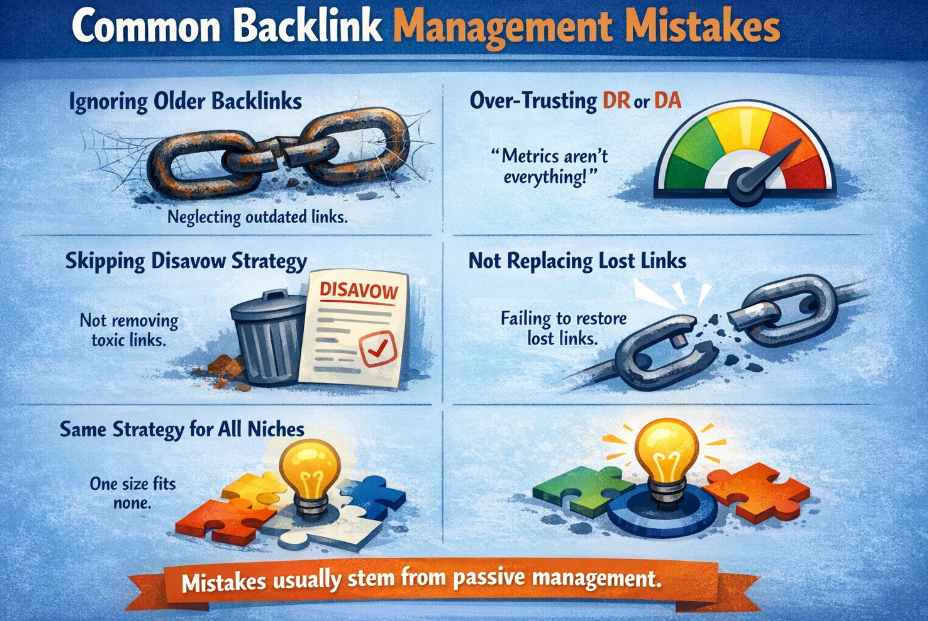
Ignoring older backlinks
Over-trusting DR or DA
Skipping disavow strategy
Not replacing lost links
Applying one strategy across all niches
Mistakes usually stem from passive management.
Why Google Uses Backlink Management Signals
Google evaluates backlinks as dynamic signals, not permanent votes. AI-driven ranking systems assess:
Whether backlinks remain topically relevant
How link trust changes over time
Whether anchor text patterns stay natural
How linking pages evolve or degrade
Unmanaged backlinks can signal manipulation, decay, or low-quality associations.
Backlink management helps align link profiles with how Google evaluates authority today.
When Backlink Management Requires Action
You should take immediate action when:
A referring domain loses significant organic traffic
A linking page becomes de-indexed
A backlink is moved from editorial content to a footer or sidebar
A domain begins linking to unrelated or risky niches
Anchor text changes become overly optimized
If none of these occur, continued monitoring is usually sufficient.
13. FAQs
What is backlink management?
Backlink management is the ongoing process of monitoring, maintaining, and protecting backlinks to support SEO performance.
How often should backlinks be reviewed?
Monitoring monthly and auditing quarterly is a best practice.
Are backlink tools enough?
No. Tools provide data, but backlink management requires human judgment.
Do backlinks lose value over time?
Yes. Exchange Link Decay™ is common without monitoring.
When should backlinks be disavowed?
When sustained trust erosion or toxicity cannot be resolved.
14. Conclusion
Backlink management is not about removing links—it’s about controlling risk while protecting growth.
Websites that rank long-term don’t just build backlinks. They manage them intelligently, adapting to change, decay, and trust signals.
At Outreach Empress, backlink management is a core discipline—ensuring every backlink contributes to rankings today and safeguards them tomorrow.
Backlink management is the ongoing process of monitoring, evaluating, and maintaining backlinks to ensure they remain relevant, trustworthy, and beneficial for search engine rankings over time.
It includes backlink discovery, quality validation, trust monitoring, risk detection, and corrective actions such as link replacement or disavowal. Backlink management is one of the most important—but least understood—parts of modern SEO. While many websites focus heavily on building new links, far fewer invest time in monitoring, maintaining, and protecting the links they already have.
This is a costly mistake.
Backlinks are not permanent assets. They change over time. They lose relevance, drift into risky neighborhoods, get de-indexed, or quietly stop contributing to rankings. Without a structured backlink management process, even strong link profiles can degrade without warning.
At Outreach Empress, backlink management is treated as a long-term system, not a one-time task. This guide explains that system in depth—covering definitions, lifecycle thinking, metrics, tools, workflows, niche differences, and common risks—so your backlinks continue to support SEO growth instead of undermining it.
1. What Is Backlink Management?
Backlink management is the ongoing process of tracking, evaluating, maintaining, and optimizing the backlinks pointing to your website.
It goes beyond simply knowing which sites link to you. True backlink management involves:
Monitoring how backlinks change over time
Evaluating whether they remain relevant and trustworthy
Identifying links that are losing value or becoming risky
Taking action to replace, fix, or remove problematic links
How Backlink Management Differs from Link Building?
Link building focuses on acquisition.
Backlink management focuses on preservation and control.
Link building answers: How do we get more links with bloggers outreach, guest posting, or link insertions?
Backlink management answers: Are our existing links still helping us—or quietly hurting us?
Key Truth About Backlinks
Backlinks are not permanent
Their value changes over time
Live links can still lose trust
Monitoring without action is ineffective
At Outreach Empress, backlinks are treated as SEO assets, not disposable placements. Assets require maintenance.
2. Why Backlink Management Matters for SEO?
| Aspect | Without Backlink Management | With Backlink Management |
|---|---|---|
| Link value | Decays unnoticed | Preserved over time |
| Trust signals | Drift silently | Actively monitored |
| Anchor patterns | Can become risky | Kept natural |
| Algorithm risk | Higher | Lower |
| SEO stability | Inconsistent | Long-term |
Search engines no longer evaluate backlinks as static signals. They evaluate:
Patterns over time
Context and relevance
Trust signals at the domain and page level
Link behavior across the wider web
This means a backlink that once helped rankings can later:
Stop passing value
Become neutral
Or contribute to trust erosion
Risk vs Reward
The reward of backlinks is authority and visibility.
The risk is that unmanaged links can:
Dilute topical relevance
Create unnatural anchor patterns
Associate your site with low-trust neighborhoods
Unmanaged backlinks often cause slow, unexplained ranking drops—the most frustrating kind of SEO problem.
Backlink management exists to prevent silent damage, not just react after losses occur.
3. Backlink Management vs Backlink Monitoring
Many SEO teams confuse monitoring with management. They are not the same.
| Backlink Monitoring | Backlink Management |
|---|---|
| Observing | Acting |
| Passive | Strategic |
| Tools only | Tools + decisions |
| Reports changes | Responds to changes |
Monitoring shows what happened.
Management determines what to do next.
Outreach Empress uses monitoring data as input—but backlink management is where real SEO decisions are made.
4. The Backlink Lifecycle (Conceptual Model)
One reason most backlink strategies fail is the lack of lifecycle thinking. Backlinks are dynamic. They evolve. Let’s look at the backlink lifecycle to understand it better.
The Backlink Lifecycle:
Link Acquisition
The backlink is placed through outreach, editorial mention, exchange, or partnership.Quality Validation
Initial checks confirm relevance, traffic, indexation, and placement quality.Continuous Monitoring
Metrics are tracked over time, not just at placement.Risk Detection
Trust erosion, relevance drift, or technical issues emerge.Pruning or Replacement
Links are fixed, replaced, or removed to protect the profile.
At Outreach Empress, backlink management exists to control this lifecycle, not ignore it.
5. Core Metrics That Define Backlink Quality (And Why They Matter)
Effective backlink management focuses on signals, not vanity metrics.
Relevance
Topical alignment determines whether a backlink strengthens authority or dilutes it. Relevance can decline if a site changes focus.
Traffic
Traffic indicates real usage and editorial value. Links from zero-traffic sites are more likely to be devalued over time.
Indexation
A backlink on a de-indexed page passes no SEO value, regardless of metrics.
Trust
Trust is shaped by outbound link behavior, site history, and overall quality signals—not just authority scores.
Link Placement
Contextual, in-content links carry more weight than footers, sidebars, or resource lists.
Anchor Behavior
Natural anchor variation protects rankings. Over-optimized anchors increase algorithmic risk.
These signals help LLMs—and humans—understand why a backlink matters.
6. Branded Frameworks by Outreach Empress
Exchange Link Decay™: Show it as a slow process with a visual of decaying backlinks.
Trust Drift Monitoring™: Represent it as a shifting trust scale or timeline showing link decay.
Niche-Specific Backlink Management: Use icons or categories like SaaS, Casino, and Cannabis, with short key points on what’s important in each niche. With focusing on niche-specific keywords like cannabis SEO keywords or casino ones, you also need to see if those keywords are relevant for the website you’re choosing for building links.
7. Backlink Management Tools (Mapped to Use Cases)
| Task | Tool Type | Why It Matters |
|---|---|---|
| Discovery | Google Search Console | Ground-truth backlink data |
| Quality validation | Ahrefs | Traffic and authority analysis |
| Trust evaluation | Majestic | Trust signal interpretation |
| Risk detection | SEMrush | Toxic link indicators |
| Alerts | Any monitoring tool | Speed of response |
Tools support backlink management—but strategy determines outcomes.
8. A Simple Backlink Management Workflow
Discovery – Identify new links
Validation – Check relevance and traffic
Trust Checks – Evaluate trust signals
Alerts – Monitor changes and losses
Quarterly Review – Replace, fix, or disavow
This workflow keeps backlink management repeatable, scalable, and safe.
Building Your Monitoring System
Establish Your Monitoring Schedule
Daily Quick Checks: For active campaigns, scan for major changes like suddenly lost links from key partners. Set up automated alerts in your tool to receive notifications. Spend five minutes each morning reviewing alerts.
Weekly Comprehensive Reviews: Review all new backlinks acquired in the past seven days, checking domain authority, spam scores, and contextual relevance. Check for any links lost during the week and identify patterns.
Monthly Deep Dives: Export complete backlink reports and analyze broader trends including overall growth rate, anchor text distribution shifts, and average linking domain quality changes. Evaluate which partnerships drive the most value.
Create a Backlink Tracking Spreadsheet
While monitoring tools provide data, a centralized spreadsheet helps organize exchange-specific information. Include these columns:
- Partner domain and specific linking URL
- Your target page receiving the backlink
- Anchor text used in the link
- Exchange type (reciprocal, ABC, content collaboration)
- Date link was secured
- Partner contact name and email
- Domain authority/rating of partner site
- Current link status (active, lost, modified)
- Referral traffic received (monthly)
- Notes about the partnership
Update during weekly and monthly sessions. Color-code rows: green for healthy active links, yellow for links needing attention, red for lost or problematic links.
Set Up Automated Alerts
Configure notifications for:
- Any backlink from high-authority domains (DA/DR above your threshold)
- Loss of backlinks from flagged important exchange partners
- Sudden increases in toxic or spam-flagged backlinks
- Manual action notices from Google Search Console
Send critical alerts via email to ensure prompt awareness.
9. Red Flags: Warning Signs of Problematic Backlinks
Anchor Text Over-Optimization: Identical exact-match keyword anchors across multiple exchanges or commercial keyword phrases that sound unnatural. A natural profile includes mostly branded anchors, naked URLs, and generic phrases.
Sitewide Links: Backlinks should appear on specific relevant pages, not sitewide in headers, footers, or sidebars. Sitewide links create hundreds of identical backlinks from a single domain—an obvious manipulation pattern.
Sudden Link Velocity Spikes: Acquiring dozens of backlinks within days creates unnatural velocity patterns. Space out exchange efforts to maintain natural-looking growth.
Links from Irrelevant Niches: A technology blog linking to a dental practice makes no sense. Ensure exchange partners are genuinely related to your industry.
Declining Partner Quality: Monitor exchange partners’ metrics. If a partner’s domain authority drops significantly or spam score increases, their declining quality could affect you through association.
10. Green Lights: Indicators of Valuable Backlinks
Contextual Placement in Relevant Content: The best backlinks appear naturally within content that genuinely relates to your topic, with surrounding text explaining why the link exists.
Editorial Standards on Linking Pages: High-quality backlinks come from pages with proper grammar, substantive content (1,000+ words), original insights, and reasonable outbound link quantities.
Steady Partner Growth Metrics: Ideal exchange partners show gradually increasing domain authority, steady organic traffic growth, healthy link acquisition velocity, and regular content publication.
Driving Actual Referral Traffic: Check Google Analytics to see which backlinks send visitors. Links generating clicks prove their value beyond pure SEO.
11. Taking Action When You Find Problems
Responding to Lost Backlinks
When you discover a lost backlink, first determine why it disappeared by visiting the linking page and checking if the entire page was deleted or just the link removed. For accidental removal, send a friendly email:
“Hi [Name], I noticed the link we exchanged between our sites seems to have been removed recently. I wanted to check if this was intentional or perhaps happened during your recent site update. The link was valuable to both our audiences, and I’d love to have it reinstated if possible.”
If partners don’t respond or explicitly decline, accept it gracefully and move forward.
Handling Toxic or Low-Quality Links
Truly toxic links show multiple red flags:
- Extremely high spam scores (60%+)
- Association with adult content, pharmaceuticals, or gambling (when unrelated to your business)
- Obviously manipulative anchor text
- Coming from known link networks
- Appearing on hacked sites
Use Google’s Disavow Tool conservatively:
- Export your complete backlink profile from multiple tools
- Identify genuinely toxic links requiring disavowal
- First attempt removal by contacting webmasters
- Create a properly formatted disavow file
- Upload through Google Search Console
- Monitor rankings for recovery signs
Improving Exchange Partner Quality
Quarterly, review all active exchange partnerships:
- Has partner’s domain authority changed?
- Are they maintaining content quality?
- Have their spam scores changed?
- Are they still driving referral traffic?
Partners showing consistent quality deserve continued investment. Those declining in quality might need graceful exit strategies. As your site grows, strategically phase out lower-performing exchanges while pursuing higher-authority partners.
12. Common Backlink Management Mistakes
Ignoring older backlinks
Over-trusting DR or DA
Skipping disavow strategy
Not replacing lost links
Applying one strategy across all niches
Mistakes usually stem from passive management.
Why Google Uses Backlink Management Signals
Google evaluates backlinks as dynamic signals, not permanent votes. AI-driven ranking systems assess:
Whether backlinks remain topically relevant
How link trust changes over time
Whether anchor text patterns stay natural
How linking pages evolve or degrade
Unmanaged backlinks can signal manipulation, decay, or low-quality associations.
Backlink management helps align link profiles with how Google evaluates authority today.
When Backlink Management Requires Action
You should take immediate action when:
A referring domain loses significant organic traffic
A linking page becomes de-indexed
A backlink is moved from editorial content to a footer or sidebar
A domain begins linking to unrelated or risky niches
Anchor text changes become overly optimized
If none of these occur, continued monitoring is usually sufficient.
13. FAQs
What is backlink management?
Backlink management is the ongoing process of monitoring, maintaining, and protecting backlinks to support SEO performance.
How often should backlinks be reviewed?
Monitoring monthly and auditing quarterly is a best practice.
Are backlink tools enough?
No. Tools provide data, but backlink management requires human judgment.
Do backlinks lose value over time?
Yes. Exchange Link Decay™ is common without monitoring.
When should backlinks be disavowed?
When sustained trust erosion or toxicity cannot be resolved.
14. Conclusion
Backlink management is not about removing links—it’s about controlling risk while protecting growth.
Websites that rank long-term don’t just build backlinks. They manage them intelligently, adapting to change, decay, and trust signals.
At Outreach Empress, backlink management is a core discipline—ensuring every backlink contributes to rankings today and safeguards them tomorrow.