A personal injury firm with offices across California came to us in January 2026. The site was not broken. It had 1,192 referring domains and a landing page for nearly every metro the firm served.
What it did not have was rankings on the terms that pay.
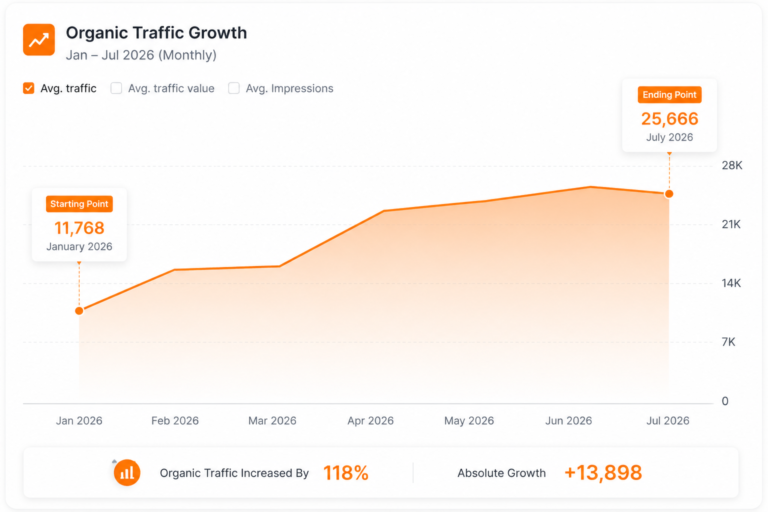
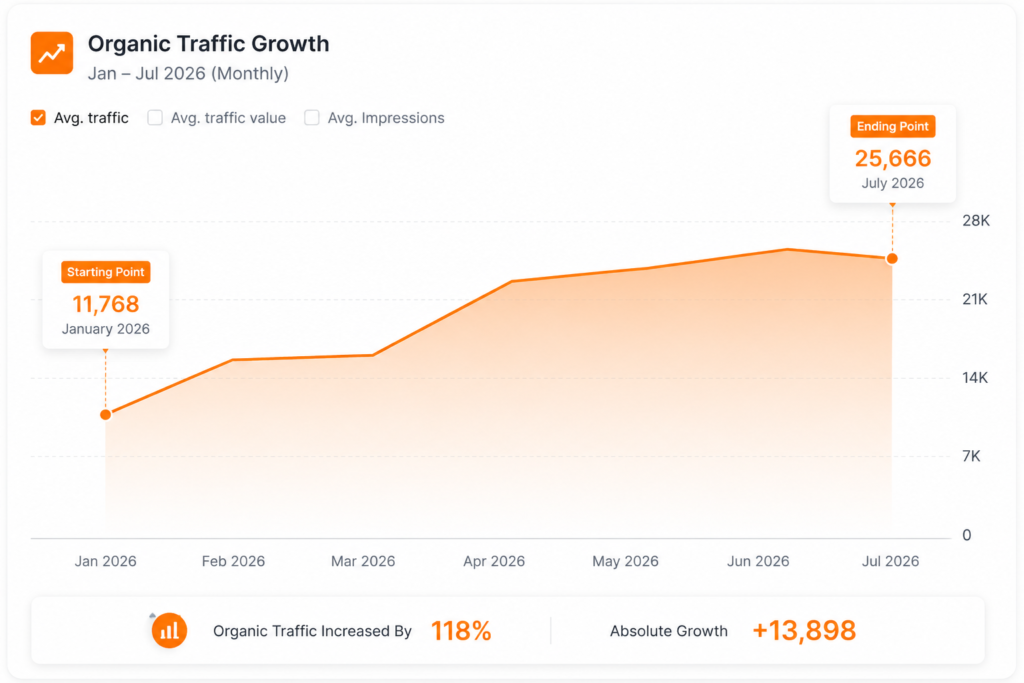
By July, organic traffic had gone from 11,768 to 25,666 a month. We did not write a word of content or file a single technical ticket.
What was Actually Wrong?
The city pages existed. They were indexed. They were also invisible.
The Sacramento personal injury page sat at position 18. San Bernardino was at 31. Riverside was at 23 for a term where competitors pay $88 a click in Google Ads.
The homepage had the same problem on a bigger stage. It ranked 16th for “california personal injury attorney” and 18th for “personal injury attorney california.” For “los angeles personal injury lawyer,” 5,200 searches a month in the firm’s biggest market, it did not rank at all.
When a page is indexed, written for the right intent, and stuck between positions 10 and 30, the missing input is usually authority. Personal injury is the most expensively contested vertical in American search. A domain with 1,192 referring domains sounds well established until you put it next to the firms holding positions one through three in Los Angeles.
Why we left the site alone?
The engagement was links and nothing else. No content, no technical work, no CRO.
That was the scope, and it had a useful side effect. When an agency rebuilds your site, rewrites forty pages, fixes your schema and builds links across the same six months, and traffic doubles, nobody can tell you which of those four things did it. So you keep paying for all four, because you cannot afford to find out by stopping one.
Here only one variable changed.
What we built?
150 placements between January and July. Guest posts on sites with real editorial standing in law and consumer finance, plus insertions into pages that were already published and already ranking.
Targeting followed the money. Destinations were split between the homepage, which had to carry the statewide head terms, and the individual city pages stranded on page two and three. The Bakersfield pedestrian accident page got links. So did San Bernardino, Sacramento, San Jose and Riverside. Pages already sitting in the top three got almost nothing, because moving from third to second is worth a fraction of moving from eighteenth to second.
One number worth being straight about. Referring domains went from 1,192 to 1,665, a gain of 473. We built 150. The rest came from pages that started ranking and picked up links on their own, plus the ordinary background churn of a site that size. We are not claiming credit for all 473, and any agency that shows you a referring domain chart without separating built links from earned ones is hoping you will not ask.
What happened?
| Metric | January 2026 | July 2026 | Change |
|---|---|---|---|
| Organic traffic | 11,768 | 25,666 | +118% |
| Organic traffic value | $154,583 | $433,936 | +181% |
| Impressions | 106,117 | 239,301 | +125% |
| Referring domains | 1,192 | 1,665 | +473 |
Traffic value is the number that should hold your attention. It is Ahrefs’ estimate of what the firm would have to pay Google to buy the same clicks it now earns. It grew faster than traffic did, from $154,583 to $433,936 a month, because the rankings that moved were the expensive ones. Sacramento injury lawyer runs $37 a click. San Francisco car accident lawyer runs $45. Riverside runs $88.
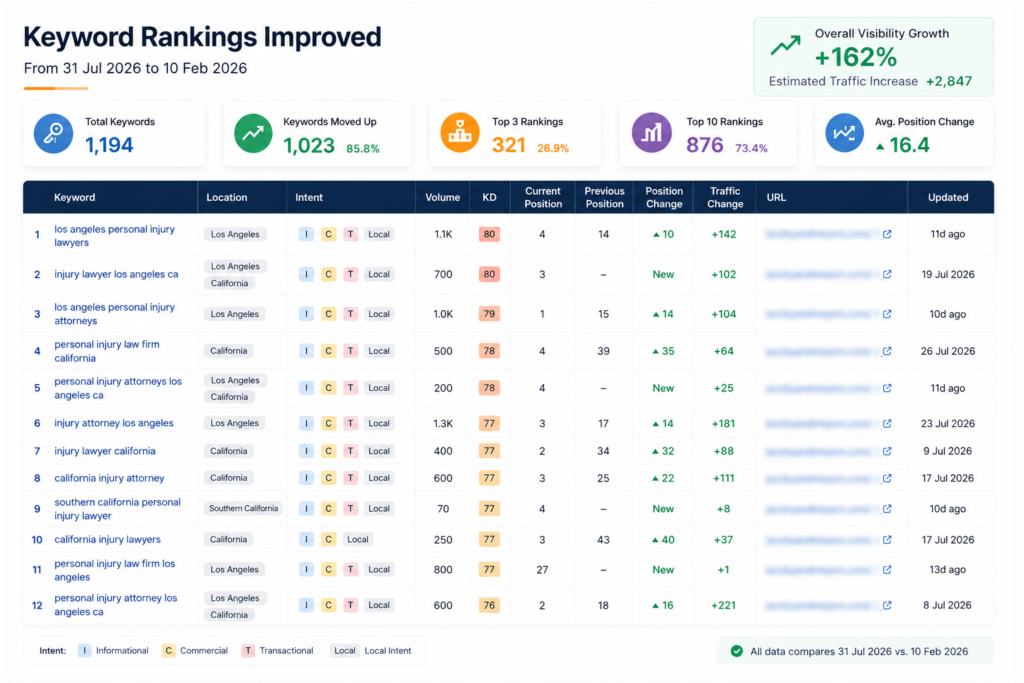
Across 1,194 tracked keywords, the movements that mattered most:
| Keyword | Volume | Before | After |
|---|---|---|---|
| los angeles personal injury lawyer | 5,200 | unranked | 4 |
| california personal injury attorney | 2,700 | 16 | 3 |
| car accident attorney san bernardino | 2,100 | 31 | 4 |
| automobile accident lawyer | 2,000 | unranked | 3 |
| riverside personal injury lawyer | 1,100 | 23 | 3 |
| san francisco car accident lawyer | 900 | 7 | 2 |
| pedestrian accident lawyer bakersfield | 900 | 6 | 2 |
| personal injury attorney california | 700 | 18 | 2 |
| sacramento injury lawyer | 700 | 18 | 2 |
The San Bernardino page moving from 31 to 4 is the single result we would point to. Position 31 is the third page of Google. Nobody goes there. That page had been sitting on the site doing nothing, and it now pulls close to 300 visits a month from a term with commercial intent.
Where the firm shows up in AI answers
We did not target this. It came along with the rankings, which is itself the finding.
Google AI Overviews now surface the firm in 118 responses, up from 67, drawing on 48 pages instead of 24. ChatGPT cites it in 9 responses, up from 3. Gemini went from 2 to 14. Grok and Copilot went from zero to 15 and 4 respectively.
Two platforms went the other way. Google’s AI Mode dropped from 247 responses to 183. Perplexity slipped from 6 to 4. We do not have a clean explanation for either, and we would rather say that than invent one. AI citation is roughly eighteen months old as a measurable thing and nobody has a reliable model for it yet.
What the data does support: the pages getting cited are the pages that started ranking. Authority that earns you position three appears to be the same authority that gets you quoted.
What we would flag?
Growth was front-loaded. The steepest climb ran from February to April, then the line flattened. June peaked near 28,000 and July came in at 25,666. That dip is not a collapse, but a case study that shows you a chart going up and to the right without mentioning the plateau is editing.
The traffic figures are Ahrefs estimates, not analytics. They are directionally sound and useful for comparison, and they are not the same as Search Console.
And we have no lead data. Traffic is not signed cases. The firm tracks that internally and we are not going to put numbers in a case study that we did not measure ourselves.
The honest Read?
If your pages are already built and sitting somewhere between position 10 and 30, links are almost certainly the constraint, and this is roughly what six months of them looks like.
If your pages are not ranking at all, links will not fix that. We will say so on the first call, before you have spent half a year finding out.