
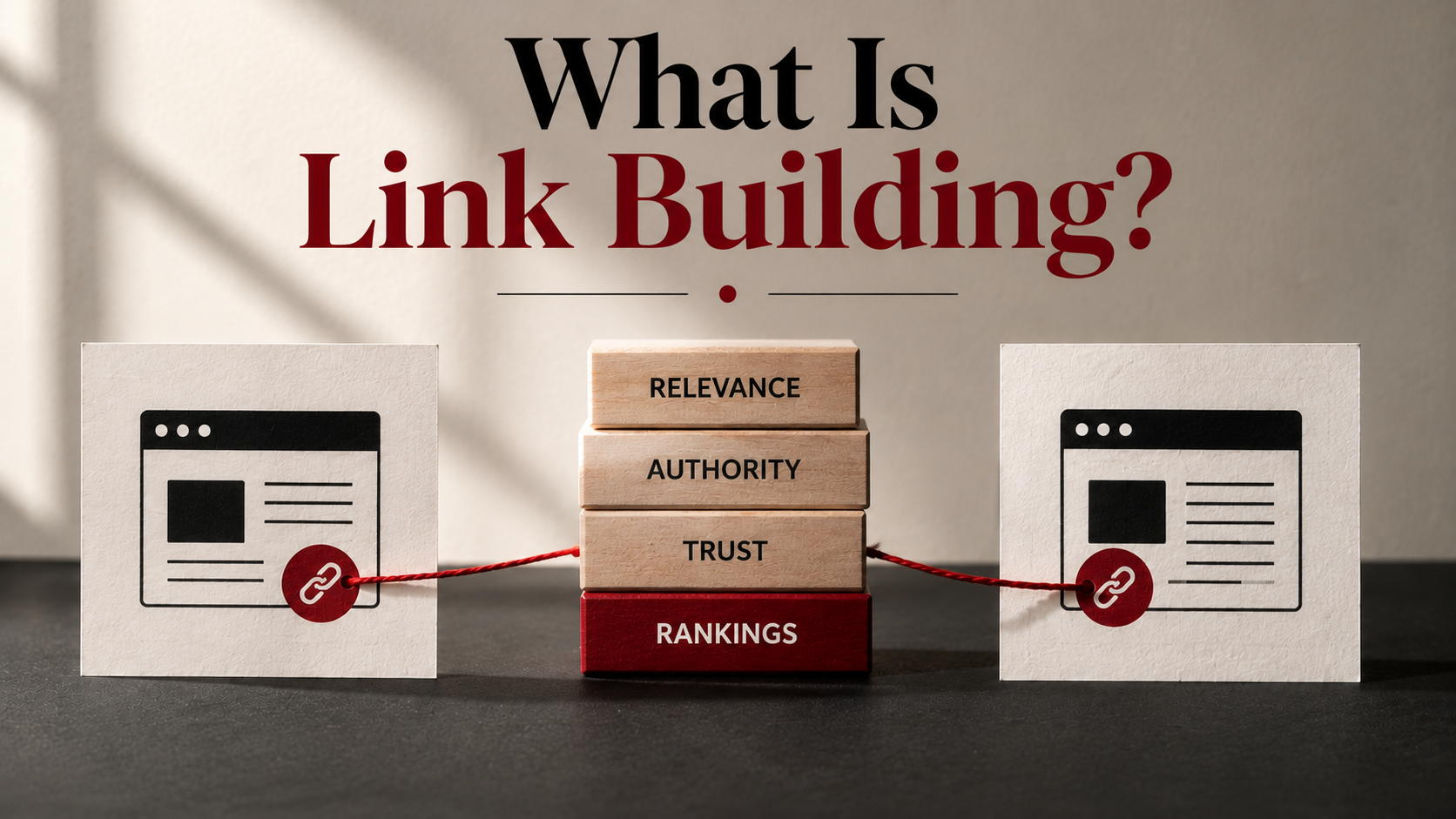
Link building is the practice of getting other websites to link to yours. Search engines treat those links as signals of trust, so pages with more of them, from better places, tend to rank higher.
You probably knew that before you clicked. The definition was never the hard part.
The hard part is what comes after it. How many links you actually need. What a fair price looks like. Which sites are worth paying for and which ones only look like they are. Whether the links you already bought did anything at all.
Almost nobody answers those, and the reason is structural. Every agency and every link builder is paid on how many links they sell, not on how many you need.
I have run Outreach Empress, a link building agency for seven years, and selling links is the only income I have ever had. That makes me the wrong person to ask whether you need links, and the right person to ask what they cost. So the rest of this is our numbers. Seven in ten sites we assess get rejected before anyone writes an email. In our last campaign, 89% of the links we placed were indexed, which is a low bar that most of this market does not clear.
Some of those numbers make us look good. Some of them do not.
Key Takeaways
- Link building is the practice of convincing other authority websites to link to yours, because search engines treat those links as signals of trust.
- A link’s value comes mostly from relevance and from whether real people read the page it sits on. Domain authority scores such as DA, DR or AS are third-party estimates and easy to inflate.
- Nearly every agency selling link building at volume is paying somewhere in the chain. What varies is what the payment buys.
- A blog page usually needs 8 to 10 links to rank. A commercial page needs 30 to 35.
- Placements cost from $150 for a small niche-relevant site to around $1,000 for a large one, and roughly double that in restricted niches like cannabis and casino.
- Most links take two to four weeks from pitch to live. Around 70% of us are still alive five years later.
- Under about $1,000 a month, link building is the wrong purchase.
Link Building Explained
The process of getting a hyperlink from someone else website to yours is known as Link Building. Isn’t it easy to hear? Find a website, go ask for a backlink, they link to yours, you got increased authority, Google rank your site, you got customers, and everything settle out.
But that’s just a day-dreaming. Building links isn’t easy the way it sound. If it was, we wouldn’t have been handling links for 50+ brands, and generating over $70k/month.
Both link building, and backlinks are two different things. Backlinks are the outcome, and link building is the process behind it. People use the terms interchangeably and it rarely causes confusion.
Search engines treat a link as a signal that someone found your page worth pointing at. Whereas LLM models like Chatgpt, and AI overviews consider them as the brand mentions. Get more signals from the right places, and your pages rank higher for the terms you care about. That is the whole mechanism, and everything below is detail on how search engines decide which links count.
It is also one part that most SEO companies outsource, for a simple reason. Writing your own content is work you control. Getting a stranger to publish a link to you is work you cannot do alone, at scale that only makes sense with a team doing it full time.
What is the Value of Link Building in My SEO Strategy?
Backlinks are the part of a SEO, not the SEO. Try to understand it this way:
- Ron is searching for a pair of “men running shoes” that your company sell.
- But Ron usually compare the sites appearing on the first page of his mobile.
- So to convert him into a customer, you need to put your site on the first page.
So everything depends on a customer journey. The only order that matters for your website is:
- A user must have been searching for what you sell
- Your page has to be worth putting in front of them.
- Google has to be able to crawl and index your website.
Once your site passed all these 3 steps, then only links will help you. No amount of links can fix thin and low quality content. They will neither fix a site Google cannot render, nor create demand for a product nobody is looking for.
Where links are usually the constraint is narrower and more specific: you are sitting at position 8 to 20 on pages that are otherwise fine, your content matches what the searcher wanted, and the sites above you have more of something you do not have. That something is almost always links.
If you are not ranking at all, the problem is upstream and links will not touch it.
What A Good Link Is Made of?
Let’s talk about what make a link good in detail.
1. The parts of a link
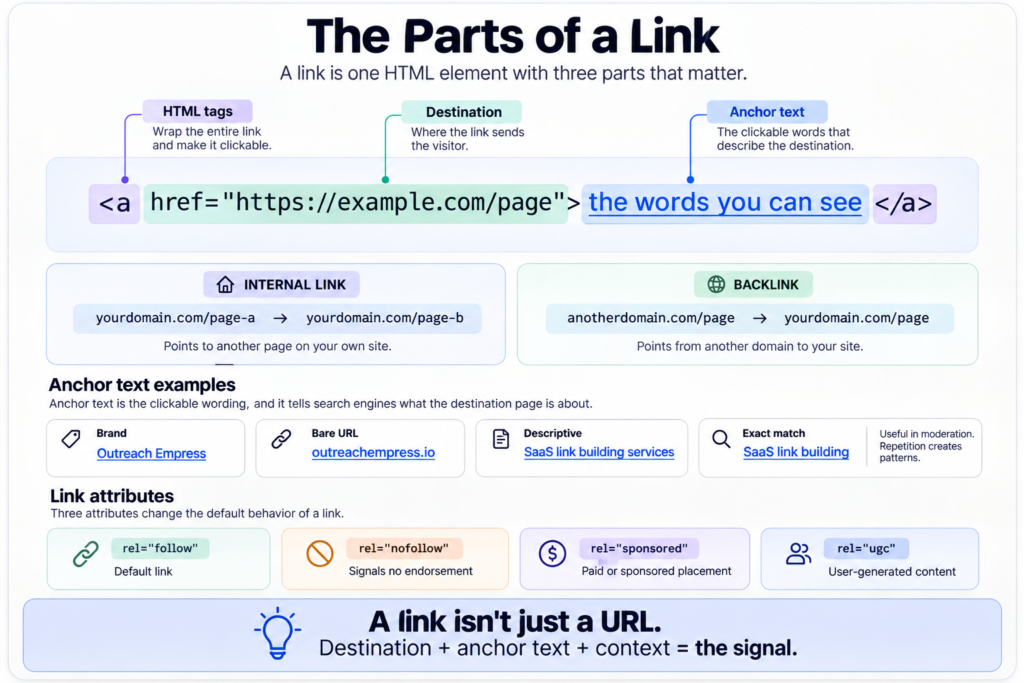
A link is one HTML element with three parts that matter.
the words you can seeThe href is the destination. The visible words are the anchor text. The <a> tags wrap the whole thing and turn it into something clickable.
Search engines read all three. The destination tells them which page is receiving the signal. The anchor text tells them what that page is about. And the surrounding content tells them whether the link makes sense at all, which turns out to matter more than either.
2. Internal and External Links
An internal link points from one page on your site to another page on your site. An external link, or backlink, comes from a different domain.
The difference is control. You can add an internal link this afternoon. An external link requires a person you have never met to agree to something. That asymmetry is why one of these has an industry built around it and the other does not, and it is also why internal linking is the cheapest ranking work available to most sites. We will come back to it later.
3. Anchor text
Anchor text is the clickable wording, and it tells search engines what the destination page is about.
The old approach was to make it match your target keyword as often as possible. That approach now creates a pattern, and a pattern is what gets a link profile looked at. When forty sites all link to your product page using the exact phrase you are trying to rank for, no reasonable reading of that is editorial.
A profile that looks normal is mostly your brand name, your bare URL, and descriptive phrases a writer would plausibly type. Exact-match anchors exist in it, sparingly, because they occur naturally. There is no safe ratio to publish here, because anyone who publishes one hands over a target to aim at.
Follow, Nofollow, Sponsored and UGC
By default a link passes ranking signal. Three attributes change that.
rel=”nofollow” tells search engines not to treat the link as an endorsement. It was introduced in 2005 to fight comment spam, and since 2020 Google has treated it as a hint rather than an instruction, meaning it may still be used. rel=”sponsored” marks links that were paid for or exchanged. rel=”ugc” marks user-generated content like comments and forum posts.
Most link building targets followed links, because those are the ones that carry ranking weight. But there is a finding worth knowing before you write off the rest. Research published by Semrush with Kevin Indig found that nofollow links had close to the same effect on visibility in AI-generated answers as followed ones. If a meaningful share of your buyers are asking ChatGPT instead of Google, that changes the arithmetic on which links are worth having.
Stop being scared of nofollow. Seriously, it’s not 2010. Some of the best links on the internet are nofollow by default. Take an example of medium.com.
Why Links Are Crucial in 2026, and Does Google Really Count Links?
Google started as a paper about links. PageRank, written by Larry Page and Sergey Brin at Stanford in the late nineties, treated a link as a vote and treated votes from important pages as worth more than votes from unimportant ones.
Most guides spend a thousand words here. The concept has not changed and the implementation is unrecognisable, so we will move on.
What Does the 2024 leak showed?
In May 2024, roughly 2,500 pages of internal Google Search documentation appeared publicly. Google confirmed the documents were real while cautioning that they lacked context and might be outdated or unused.
Read carefully, they describe a system that stores far more about a link than whether it exists. There are references to classifying sources by type and tiering the index by quality, to detecting anchor text spam, and to tracking the rate at which links arrive. None of that proves how any of it is weighted today, and anyone telling you the leak revealed the algorithm is overreading it.
What it does support is a shift in emphasis that practitioners had already noticed. The question stopped being how many links point at a page, and became which ones the system considers worth counting.
SpamBrain and Site Reputation Abuse
In December 2022 Google’s link spam update began using SpamBrain to neutralise links rather than penalise the sites receiving them. The practical effect is that bad links usually now do nothing, which is worse than it sounds if you paid for them. You get no penalty and no benefit, and no signal that anything went wrong.
In March 2024 Google published its site reputation abuse policy, aimed at third-party content published on an established domain to exploit that domain’s ranking strength. It was tightened in November 2024 to cover cases where the host site was involved. This is the policy that governs a large share of cheap link inventory, and every guide on this topic recommends guest posting without mentioning it.
How Does Google Judges the Link Quality?
Here are the top 7 factor on which Google evaluates the quality of a backlink:
1. Topical Relevance
Relevance is the first filter and the one most often skipped, because it is harder to buy than authority. Also when we talk about relevance, you need to understand two terms:
- Site level relevance
- Page level relevance
Site-level relevance asks how well the publication covers your subject at all. Whereas, the page-level relevance asks whether the specific article your link sits in is about something adjacent to what you do.
A link can pass one and fail the other, and the version that fails page-level relevance is the more common failure: a genuinely relevant publication running a piece that was clearly commissioned to carry your link.
2. Relevance against Authority, When They Conflict
You will face this choice constantly in link building. A DR 70 site that has never covered your subject, or a DR 30 site whose readers are your buyers.
Take the DR 30 site. Always and never look back to that DR 70 site.
The only exception is when you are building a profile from nothing and need some baseline authority in the mix, or when the high-authority site is genuinely running a section on your topic instead of accepting anything. What should not sway you is the score by itself, which brings us to the scores.
3. Domain Authority and Page-level Authority
Domain Rating from Ahrefs, Domain Authority from Moz and Authority Score from Semrush are all third-party estimates. Google does not publish an authority metric and does not use theirs. They are useful for sorting a list of candidates. They are not evidence.
They are also the easiest number in SEO to inflate, and the sites that inflate them are the sites selling links.
More usefully, authority accrues at page level as well as domain level. Ahrefs calls this URL Rating. A link from a strong domain’s forgotten page is worth much less than the domain score implies, and this is where most money in link building gets wasted. When a domain scores 71 and the page you would be published on scores 11, you are buying a number, not an outcome.
4. Referring Domains against Total Links
A hundred links from four sites is closer to four links than to a hundred.
Referring domains counts the unique sites linking to you. Total backlinks counts every individual link, including twelve from the same site’s sidebar. Sellers quote the second number. The first is the one that reflects how many independent sources chose to point at you.
5. Where the LInk sits on the Page?
A link inside the body of an article, in a sentence that would exist without it, carries more than one in a footer, a sidebar, or an author bio. This is not controversial and it is worth checking before you pay, because bio links are cheap to supply and are routinely sold as contextual link building placements.
6. Where the Link points?
Here is the problem nobody warns you about. The pages that earn links are research, tools, data and guides. The pages that make you money are product and service pages. Those two sets barely overlap.
Most link building fails at this join. The links land, the authority arrives, and it accumulates on a blog post that sells nothing. The fix is internal linking, and we come back to it in the ninety-day section, because it is the step that converts links into revenue and it is the step most often skipped.
7. Link Velocity
Velocity is the rate at which new links arrive. A site that has earned two links a month for three years and suddenly earns four hundred has produced a pattern, and patterns are what get profiles examined.
Velocity on its own is not a penalty trigger. A product launch or a piece of press coverage produces a spike, and a genuine spike comes with the other markers of genuine attention: traffic, branded search, links from places you did not contact. A spike without any of that has only one explanation.
8. Editorial Vs Non-Editorial Links
This one thing can make or break your link profile. An editorial link is one a writer placed because it helped their reader. Nobody asked, nobody paid, and it would still be there if you had never heard of the publication. These are the links everyone wants and the reason is obvious: they are the hardest to manufacture, so they carry the most information.
A non-editorial link is everything else. Links you requested, links you exchanged, links you paid for, links you added yourself in a directory or a profile. The label is not an accusation. Most of the web’s commercial links are non-editorial and always have been.
The useful question is not which bucket a link falls into. It is this: would an editor have published this on merit, without the arrangement?
That question survives contact with how the industry actually works in a way that white hat and black hat do not. It also sets up the next section, where we tell you exactly where our own links fall against it, including the ones that do not clear the bar.
4 Ways A Link Ends up on a Page
Ahrefs classifies the whole discipline into four buckets and the framework is good enough that inventing a worse one to look original would be a waste of your time. Links are added, asked for, bought, or earned.
1. Added Links
Links you place yourself: directories, profiles, comments. They cost nothing and are worth roughly that, with the exception of the two or three directories that genuinely matter in your industry.
2. Asked-for Links
Links are outreach. You contact someone, give them a reason, and they publish. This is most of what an agency does.
3. Bought Links
Links involve payment.
4. Earned Links
Links arrive without you doing anything, because something you published was worth citing. These are the best links and the slowest, and they are the only ones that keep arriving after you stop working.
What’s Our Stand on Paid Backlinks?
Google’s position is not ambiguous. Its spam policies name link schemes directly, and the definition includes exchanging money for links or for posts that contain links. There is no exemption for good content, careful placement, or a fair price.
Now the part the policy does not address.
A publisher has no reason to link to your pricing page. Not a weak reason. None. Editorial links happen when a writer needs to point their reader at something useful, and a page selling a product almost never qualifies. The pages that earn links on merit are research, tools, original data, and reference material. Your money pages are not those, and your money pages are the ones that have to rank.
That gap is the entire economics of this industry. Nobody is interested in helping you make more money if there is nothing in it for them. Every agency selling link building at any volume is paying somewhere in the chain, whatever their homepage says. The ones claiming a purely editorial book are either counting a very small number of links or describing work they do not do.
So we pay. Here is precisely what that buys, because the two halves of our own book are different purchases and it is dishonest to describe them as one thing.
1. Guest Post Placements, about half of What We Run.
We write the article. Our content team initiate a fresh research, an angle the publication has not run, and a piece their editor can reject, because editors do reject them. The fee compensates the publication for hosting new content, for the editorial time spent reviewing it, and in some cases for their own writer producing it under their house policy. That is a real service being paid for, and the link is contextual inside content that stands up on its own.
2. Link Insertions
We pay a publisher to add a link to a page that already exists. There is no new content and no editorial labour, and pretending otherwise would be insulting your intelligence. What we are buying is access to a page that already has relevance and readers, chosen because it ranks and because its audience is your buyer. It is a cleaner transaction and we would rather name it than dress it up.
Does either satisfy Google’s published policy? No.
The policy attaches to the payment, not to the quality of the placement, and no amount of care about relevance changes that. We are describing a risk position we have taken deliberately, not a compliance claim, and anyone who tells you their paid links are policy-compliant is selling you something.
What we think actually determines the risk is not the transaction. It is the footprint. Sites that exist to sell links, visible write for us page, or pages with no readers, templated content, exact-match anchors at volume, and publishers who will host anything for anyone. Those are what get profiles into trouble, and they are what our fifteen-parameter check exists to catch.
Roughly a quarter of our placements come through three-way exchanges instead of payment. Different mechanism, same honest description: the publisher is getting something, and we would rather you knew that than believed a story about pure editorial merit.
How We Vet Backlinks for Our Clients at Outreach Empress?
Everything above is theory you can read anywhere. This part is different, because the people who write link building guides mostly sell software, not placements.
Here is what happens between deciding you want a link and having one.
1. 7 in 10 Sites Never Get Pitched
Between February and March 2026 we assessed 170 sites for a client campaigns. We rejected 130 of them before writing a single email.
They fail for four reasons, in roughly this order of frequency.
1. Zero Relevancy
The site is not relevant. It covers your subject the way a general-interest blog covers everything, which is to say it has published one article about your industry and four hundred about other people’s.
2. AI Content Writers
The content is written by AI. Not suspected, flagged. Ahrefs now reports an AI content level per page, and on the sites we reject it commonly reads “very high” across the entire library. A publication that generates its articles is not going to review yours. We don’t have issues with the AI content but it should add some value. If the content is just repurposed, there’s no value to link from such content.
3. Link Farms
The site sells links openly. A write-for-us page with a price list tells you what the domain is for, and Google can read that page too.
4. Failed Our 15 Parameters Q&A
It failed our fifteen-parameter check. That is the catch-all, and it is worth setting out because you can run it yourself.
- Authority: Domain Rating, Domain Authority, Authority Score
- Traffic: domain traffic, page traffic, traffic value, traffic distribution, top traffic pages
- Search: organic keywords, share of organic keywords
- Fit: niche relevancy
- Profile: backlink profile, spam score, links ratio, anchor text distribution.
Three of those come from Ahrefs, two from Moz, one from Semrush. Using one vendor’s stack means inheriting one vendor’s blind spots, and a site built to look good in Ahrefs will look good in Ahrefs only.
The parameters that catch the most sites are not the authority ones. They are traffic distribution and share of organic keywords, because those are the two nobody bothers to fake.
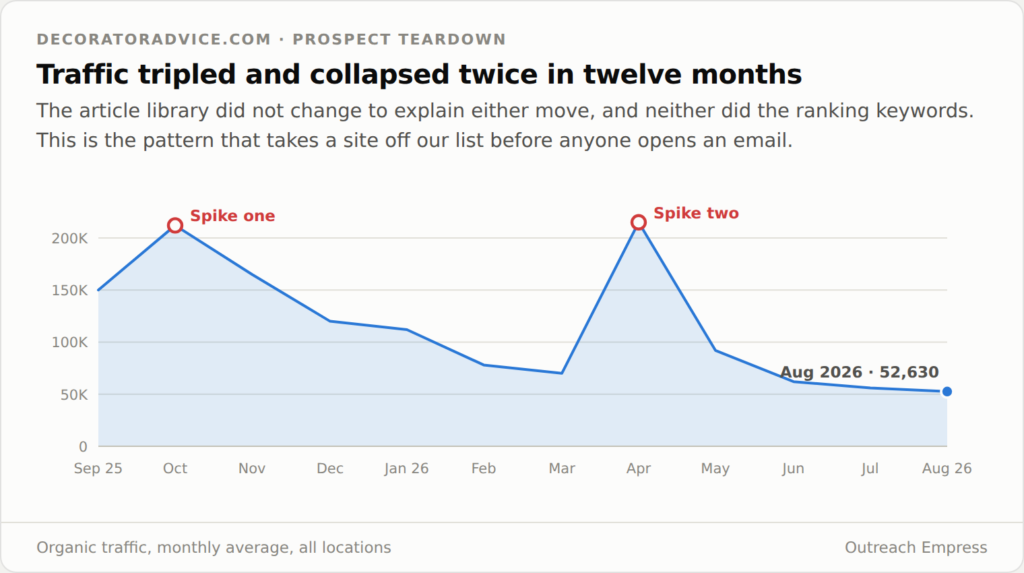
Here is one we turned down, and what it looked like.
Take an example of a domain: DecorativeAdvice.
- Uneven Traffic Chart
2. Fake & Inflated Metrics
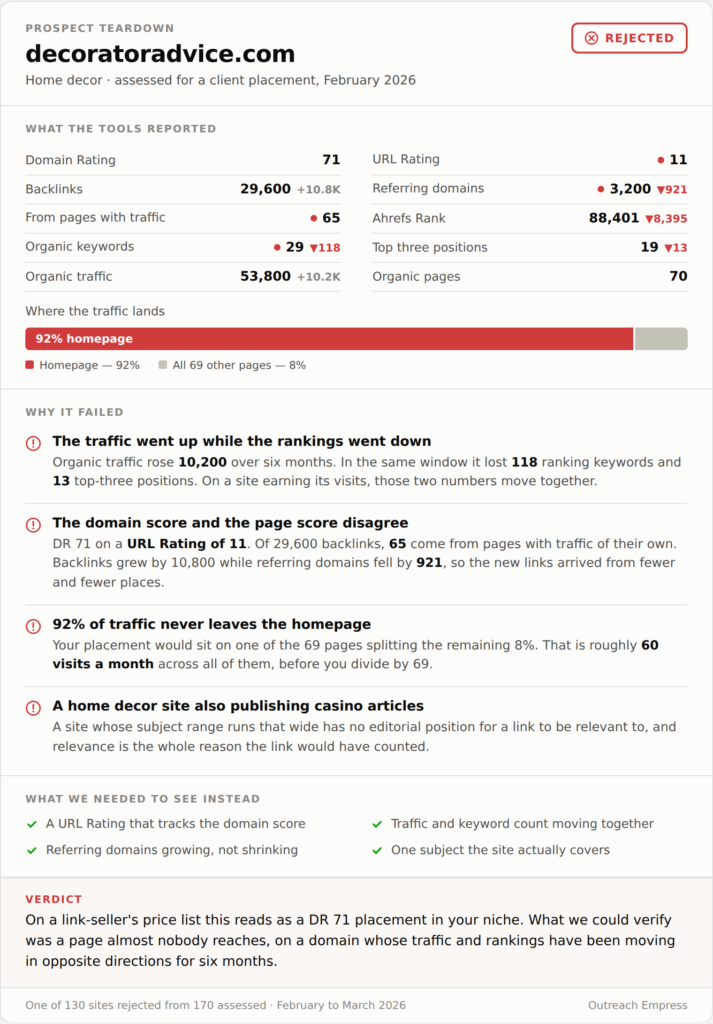
What the Numbers actually look like?
From those 170 prospects:
- 47% replied
- 29% agreed to publish
- 19 links went live
- 17 of the 19 were indexed
- 14 of the 19 appeared in AI answers
Two things in that sequence deserve comment.
The first is the gap between 29% agreeing and 19 going live. Roughly half the yeses never became a link. Some publications accept and then go quiet. Some ask for a fee after agreeing in principle. Some reject the draft, which is a good sign about them and an annoyance for us. Anyone quoting you an acceptance rate without a published-link rate is quoting the flattering half.
The second is that 85% of the yeses arrived only after a follow-up. Not a reminder that got a faster reply. The actual yes, on the second or third email. If you run outreach yourself and send it once, you are leaving most of the result on the table.
Ahrefs publishes five links from a hundred emails as a good outcome. Ours works out to about one placement per eight prospects contacted.
Why Editors Say No, and Reject Our Pitches?
The rejections that come with a reason are more useful than the silence, and they repeat.
- They will not change their writing style. You send a draft in your voice and they want it in theirs, which is reasonable and which most outreach ignores.
- They are protective of their positioning. A publication with a point of view will not run a piece that undercuts it, whatever you are paying.
- They will not link to a commercial page. This is the most common substantive objection and it is the one that matters most, because commercial pages are what you need ranked. Editors will link to a study or a tool. They will not send their readers to your pricing page.
- They will not use the anchor you asked for. Money anchors get refused. So, often, does anything that reads as instructed.
The pattern underneath all four is the same. Editors are protecting the thing that makes their site worth a link in the first place. The publications that agree to everything are the publications whose links are worth nothing, which is a neat and slightly cruel symmetry.
Our Link Building Tactics, and What Each one Risks?
We use these link building tactics for our 50+ clients to grab 2000+ links every month at our agency Outreach Empress.
| Tactic | Effort | Link quality | Scale | Risk |
|---|---|---|---|---|
| Digital PR | High | Very high | Low | None |
| Original research | High | Very high | Low | None |
| Unlinked mention reclamation | Low | High | Very low | None |
| Resource pages | Medium | Medium | Low | None |
| Broken link building | High | Medium | Low | None |
| Listicles and roundups | Medium | Medium | Medium | Low |
| Blogger Outreach | Medium | Medium | High | Medium |
| Link insertions | Low | Medium to high | High | Medium |
| Directories | Low | Very low | High | Low |
| Paid link inventory | Very low | Very low | Very high | High |
Read the risk column against what actually happens when something goes wrong, because it is rarely a penalty. Since SpamBrain, most bad links are neutralised instead of punished, so the usual outcome is that you paid and nothing happened. That is the failure mode to plan for.
Where a real penalty is possible, it comes from the two tactics at the bottom of the table, and it comes from footprint rather than from a single link. Recovery means identifying the pattern, removing what you can, disavowing what you cannot, and waiting. It takes months and it is not always complete.
A few notes the table cannot carry:
1. Digital PR
This strategy produces the links you cannot buy at any price, and it fails more often than it works. One placement in a national title can outweigh a quarter of standard outreach. Four campaigns that no journalist picks up cost the same as the one that lands.
2. Original research
The only tactic on the list that keeps earning after you stop working on it. It is also the slowest to show anything, which is why almost nobody does it.
3. Guest posting
Only works when the article is real and the publication has readers. It does nothing when neither is true, and most of what is sold as guest posting is neither. More on that below.
4. Link insertions
You can put your link on a page that already ranks and already has traffic, which means it can pass value immediately instead of waiting for a new post to get indexed and find an audience. The trade is that you are working with content you did not write.
5. Unlinked mention reclamation
Still the cheapest link you will ever get, because the publisher already decided you were worth mentioning. If you have any press coverage at all, do this before you pay anyone for anything.
6. Directories
Mostly dead, with a narrow exception: the two or three that matter in your specific industry, plus the local citations that feed Google Business Profile.
What Link Building Tactics We Avoid at Outreach Empress?
1. HARO.
Help a Reporter Out became Connectively and Connectively shut down in December 2024. It is still recommended as a live tactic by three of the highest-ranking guides on this exact topic, which tells you how much of the advice online is being maintained. The replacements are Featured, Qwoted, SourceBottle, Help a B2B Writer, and journalists posting requests directly on LinkedIn and X.
2. Reciprocal links.
You link to me, I link to you. Google’s Jagger update took this apart in 2005 and it has not recovered since.
3. Comment links.
Nofollowed by default nearly everywhere since 2005.
4. Article directories and spun content.
Killed by Panda in 2011 and by every quality update since.
5. Private blog networks.
The honest version: they still work for some people some of the time, which is why the debate never ends. The economics are the problem. You are funding a network of sites whose only purpose is links, which is the single easiest footprint for Google to identify, and when it goes it takes every client on it at once.
Why Guest Posting is Losing its Charm?
Here is the most common way money disappears in this industry.
You pay for a guest post. It publishes. You can see your link on the page. The invoice is settled and the report says one link was acquired.
Then nothing happens, because the page was never indexed.
Google stopped indexing everything years ago. After the flood of generated content, low-quality pages started being crawled and then dropped, and most guest posts are low quality by any standard Google would apply. The link exists in the sense that it is on a web page. It does not exist in the sense that anything Google has seen knows about it.
You can check this in about ten seconds. Take the URL of any guest post you have paid for, search Google for site: followed by that exact URL, and see whether it returns. If it does not, the link has never done anything and never will.
Do this with your last six placements before you buy a seventh. We publish our indexation rate for the same reason: 17 of 19 on the most recent campaign, or 89%. It is a low bar and it is one most of the market does not clear.
Mistakes with tactics that do work
- Everything points at the homepage.
Your homepage does not need the authority. Your category and product pages do.
2. Exact-match anchors at volume.
Covered above, still the most common self-inflicted damage.
3. Buying on DR alone.
The teardown earlier in this article is what that looks like from the inside.
4. Stopping after three months.
Links compound and rankings lag. Three months is roughly when the first placements are starting to register.
5. Building links to a page that cannot convert.
Ranking a page that does not sell is an expensive way to be visible.
6. No tracking.
If you cannot say which links went live, which got indexed, and which pages moved, you are not running a campaign.
Link Building Difficulty by Industry
The tactic mix changes by vertical, and mostly it changes because of who is willing to publish.
1. SaaS
SaaS is the easiest. Publications cover software, comparison and roundup content is a native format, and product-led PR works.
2. Travel and Ecommerce
These are straightforward for the same reason: gift guides, roundups and destination content all link out naturally.
3. Cannabis, Peptides, Adult and Pharma
These are the hardest, and the mechanism is worth understanding. Ad networks restrict these categories, so publishers in them cannot monetise through advertising the way a mainstream site does. Link access becomes the revenue line instead, and prices reflect that. A CBD publisher with 500 monthly visitors will ask $200 and hold firm, because sending clicks for free is not a business.
4. Casino
This is the extreme case. Nothing but money moves a placement.
5. Law
Law sits between the two, and for reasons that have nothing to do with ad networks. Legal content is held to a higher editorial standard, and state bar advertising rules make editors cautious about what a firm’s page is allowed to claim, so approval takes longer and more drafts come back. Almost all legal search is geographic, which means regional press and local citations move rankings that national coverage does not. It is also one of the few verticals where directories still carry weight, because Avvo, Justia and Martindale are read by actual clients. And it is expensive, because the firms competing with you are bidding in the highest-cost vertical in search.
If you want the detail for your industry, we have written separately about link building for SaaS, ecommerce, law firms, travel, casino, cannabis, insurance, manufacturing, franchise, enterprise and international businesses.
What Links Cost and How Long They Take?
Here is our detailed guide on how much a link cost, and how long it take us to build them.
What a link costs?
| What you are buying | Our fee |
|---|---|
| Niche-relevant site, DR 30+, 1,000+ monthly visits | $150 |
| General-interest site, DR 50+, 2,000+ monthly visits | ~$300 |
| DR 80+, 10,000+ monthly visits | $800–1,000 |
| Cannabis, casino and other restricted niches | Roughly double the above |
Those are for niche-relevant placements. We do not price general-purpose sites or the health magazines that will publish anything, because we do not use them.
Publishers set their own rates and the market moves. What closes the gap between what a publisher asks and what you pay is volume: we are negotiating across many clients at once, and a publisher who sees repeat business prices differently than one handling a single request.
For comparison, the agency ranking eighth for this search publishes $1,200 per link and cites $2,500 as an industry average. We are not going to tell you what anyone else’s costs should be. We are telling you what ours are, so you have something to hold a quote against.
How Many Links You Actually Need?
This is where most advice becomes useless, because the honest answer is that it depends and most people stop there.
It depends on two things. What the searcher wants, and how much authority the pages already ranking have accumulated.
As a working baseline: a blog post ranks with 8 to 10 links. A commercial page needs 30 to 35.
That gap surprises people and it should not. Informational queries are contested by other articles, and articles are easy to link to. Commercial queries are contested by companies who have been buying links to those same pages for years.
Here is a real one. A client selling CBD gummies wanted to rank for the purchase query, in a niche where every competitor on page one held more DR 80+ links than they did. The baseline said 30 to 35. We built 47 over two months, plus internal linking work, because the gap at the top of that page was quantity and there was no way around it. They reached first position. That was a past campaign and rankings move, so treat the number as evidence about effort, not a promise about outcomes.
How Long it Takes?
For a single placement:
- Prospecting and pitching: about 2 weeks
- Getting a reply: immediate in the good cases, up to 3 weeks with follow-ups in the slow ones
- Accepted to published: 1 to 2 weeks
That puts a typical link at 2 to 4 weeks end to end, and 90% of ours go live inside 21 days.
Then the part nobody controls. The page has to be indexed, which is usually days but sometimes never. And the ranking effect lags the link, often by weeks. If you are three weeks into a campaign wondering why nothing has moved, nothing has gone wrong. The first links are only just entering the index.
How to Tell Whether Backlinks Worked or Not?
The number one ranking page for this search gives measurement about 150 words. It is the thinnest part of the best guide on the topic, and it is where most link budgets quietly fail, so here is more.
What to Measure?
Not the link count. The link count is the invoice, not the result.
Referring domains to the specific pages you targeted. Not site-wide totals, which move for reasons unrelated to what you paid for.
Ranking movement on those URLs, for the terms they were built to win.
A control set. Pick pages you did not touch and track them alongside. When your targeted pages move and your control set does not, that is your answer. When both move, something else happened, possibly a core update, and the campaign is not the reason. Moz’s own guide uses this method and buries it in chapter eight where almost nobody reads it. It is the single most useful measurement idea in link building.
What a Monthly Backlinks Report should Show You?
For every placement: the live URL, the destination page, the link attribute, the publication date, and the site’s actual organic traffic.
If a report gives you a count and a list of domains, it is hiding the two things that determine whether you got anything. Ask for the live URLs and check them.
How Long Do links keep working?
Links decay. Almost nobody who sells them mentions it.
Across our placements, roughly 70% are still live five years later. The rest mostly disappear inside six months.
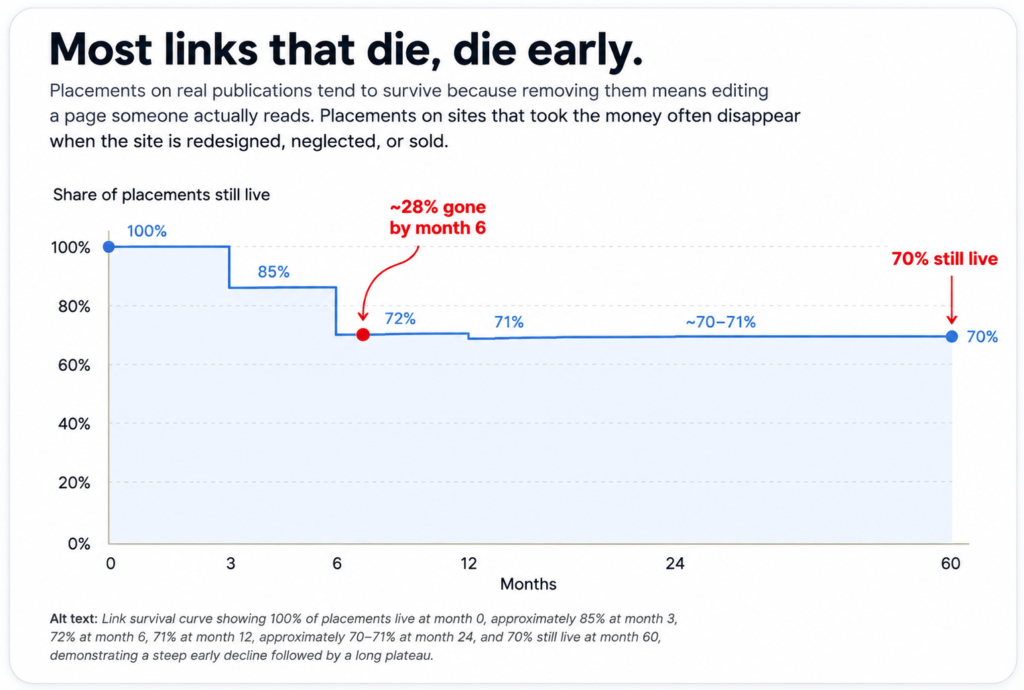
That split is sharper than people expect, and the reason is that the two groups were never the same kind of link. Placements on real publications with editorial standards stay, because removing them would mean editing a page someone still reads. Placements on sites that took the money and moved on come down when the site is redesigned, sold, or abandoned.
Which means the decay rate is not really a fact about links. It is a fact about where you put them, and it is the strongest argument for paying more for fewer.
Your Link Building Roadmap for First 90 Days
Here’s how I’ll plan the first 90 days link building roadmap for my company:
1. Audit the Existing Resources
Before you buy anything, find out what you own.
Pull your backlink profile and look for four things. Links that are gone. Links that were never indexed, using the site: check above. Links pointing at pages that no longer exist, which are wasted and easy to reclaim with a redirect. And anything that looks bought by someone who came before you.
In that last group, the modern answer is usually to leave them alone. Google’s link spam systems mostly neutralise bad links instead of penalising the site receiving them, so the typical outcome is that they do nothing at all. Disavow is for manual actions and for cases where you know a previous agency built something deliberately manipulative. It is not routine maintenance, and using it as such can remove links that were helping.
While you are in there, find your unlinked brand mentions. Somebody has already written about you without linking. Those are the cheapest links available to you and they take an email.
2. Fix the Foundation
Every link you build lands on a page, and that page passes authority onward through your internal links. If the path from your linkable content to your commercial pages does not exist, you are pouring authority into a bucket with no outlet.
This costs nothing. It is the single highest-return hour in most link campaigns and it is skipped constantly, which is why a page ranking ninth for this term does it on internal linking content alone, on a site that sells pay-per-click software.
3. Start Earning New Links
In order: reclaim unlinked mentions, then build or identify the assets on your site worth linking to, then run outreach against the pages that make money, then keep going past the point where you expect results.
When Link Building is the Wrong Purchase for You?
There are four situations where we will tell you not to buy backlinks:
1. You have nothing worth linking to.
No research, no tool, no data, no reference material. You can still buy placements, but you are buying every single one and you will keep buying forever, because nothing on your site earns anything on its own.
2. Your technical foundation is broken.
Pages Google cannot crawl or index do not benefit from links pointing at them.
3. Nobody is searching for what you sell.
Links move you up a list. If the list has no traffic, you get a better position on a page nobody visits.
4. Your budget is under the floor.
Below roughly $1,000 a month in general niches, or $2,500 in restricted ones, a link campaign does not work. Not because we will not take the money, but because of what happens next: your competitors are building too, so a handful of links a quarter never closes the gap, nothing moves, and around month four you conclude link building does not work and stop. You will have spent several thousand dollars to learn nothing.
Under the floor, the better use of the money is the work that pays back inside a quarter. Fix the pages you already rank with. Build the internal linking. Get the technical basics right. Put the rest into a channel that converts now, and come back to links when there is enough budget to run them properly.
We would rather tell you that than sell you six links and a report.
Link Building: In-House vs Outsource
In-house link building costs more than people budget for. A capable outreach person, the tooling, and the months before anyone builds relationships worth having. It makes sense at volume, and it makes sense when links are a permanent part of your growth and not a one-off project.
If you are hiring, here is what to ask.
Ask for the target list before you sign, with real domains on it. Ask what their rejection rate is and what fails. Ask for live URLs from recent campaigns and check whether those pages are indexed. Ask what happens when a link comes down.
And watch for four things. A guaranteed DR, which means they are buying on a number. A guaranteed placement count with no named targets, which means they will find something to hit the number. Per-link pricing with no relevance criteria. And any refusal to show you the sites before the work starts.
We publish our fees, our rejection rate, our indexation rate and our timelines because a buyer who can check those things is a buyer who can tell us apart from the alternative.
Frequently Asked Questions
- What is the difference between link building and backlinks?
A backlink is a link from another site to yours. Link building is the work of getting them. Same thing viewed from two ends, and the terms are used interchangeably without much confusion.
2. Is link building illegal?
No. It is not a legal question at all. Buying links breaches Google’s spam policies, which is a commercial risk, not a legal one. The consequence is search visibility, not liability.
3. What is link building in SEO with an example?
You publish original research. A journalist cites it and links to your page. That is an earned link. You email a publication offering an article for their readers, they publish it with a link to you. That is an asked-for link. Both are link building.
4. How do you do link building for SEO?
Find sites your buyers already read, check they have real traffic and a genuine editorial position, then give them a reason to link. In practice most of the work is the checking and the follow-up, not the writing.
5. Are backlinks still relevant in 2026?
Yes, and their role is widening. They remain a ranking input for classic search, and they influence which sources get retrieved and cited in AI-generated answers. Fourteen of our last nineteen placements appeared in AI answers on Google and ChatGPT.
6. How much does link building typically cost?
Our placements run from $150 to about $1,000 each, roughly double in restricted niches. Monthly retainers below $1,000 do not work in general niches.
7. Are link building and backlinks the same thing?
Effectively yes. See the first question.
8. How long does link building take to work?
Two to four weeks for a link to go live, with 90% of ours inside 21 days. Ranking movement lags that by several weeks, and a commercial page usually needs 30 to 35 links before it moves.