
I read seventeen articles about link building for law firms before I wrote this one. Sixteen of them never mention bar rules, and that’s strange.
In the last 6 years of our link building journey, law is one niche where advertsing rules apply to how you promote it. Plus, most experts warn you not to buy links, but none of them explain how to find a genuine link building agency, which has a monthly fee, a number of placements, and no obvious relationship to anything you have just been warned about.
So whether you’re a managing partner at a small practice law firm or a marketing director at a larger one, either signs it blind or passes on something that would have worked.
I run Outreach Empress since 2021. We build links for clients in the niches where the scrutiny is high and one mistake can cost you months of progress. Legal niche ranks at #3 among them. Cannabis, and Casino top the list.
Unlike other law seo experts, link buiding isn’t responsible for my bread & butter. In fact, link building is responsible for every luxury I own. Since I get paid to build links, so I’m not gonna be neutal, and this article is gonna heavily aligned towards the importance of backlinks for law firms. So read this article only if you really care about learning how backlinks can help you sign more clients for your law firm.
What I can offer in exchange is the part almost nobody publishes: what actually happens between the day a firm hires someone and the day a link goes live, and how to tell that apart from someone selling you a sentence on a website.
Link building for lawyers is the simple task of managing a way to get links from other websites to your law firm. To do this, we can use directories, local listings, guest post outreach, local citations, expert commentary in legal and local press, and content collab with other sites getting better organic results in our niche.
What people mean when they say “buying links”
The pharse “buying backlinks” cover three different phases, and lack of understanding is why the advice you have read about buying links for law firms is useless.
1. Paying Someone for Labour Cost
The first step to get links is finding relevant data. Finding sites worth approaching, analysing, pitching editors, negotiating, content writing, plaement tracking, and links reporting, need a dedicated person. So when you hire a dedicated person for this task, you need to pay a professional services fee as well. This is the fee most link building agencies, and link builders charge for.
From a naked view, it’s look like a law firm is buying links. But when you go deeper, you’ll understand that, a law firm isn’t buying the links, it has hired an agency to build links for them, and paying for thier labor cost.
2. Outreach Cost
Back in 2020, content wasn’t easily avaiable. Publishers used to offer links as a reward in exchange of no cost content. But now, every publisher understand the value of links, and mentions.
So publishers have started asking for a publishing fee. And it’s competely justified. Let’s understand the pain of publishers behind running a website, and breakdown thier cost:
- Domain Registration ($20-$100)
- Domain Renewal ($50-$200)
- Hosting Fee ($100)
- Web Development ($250 – $500)
- Content & Editing Team ($500 – $1000)
- Links and Authority Fee ($2000 – $5000)
So if you talk about real publisher, not a PBNs, a single site require a minimum of $2500 every month for its operation. Now think once again, If a site that has invested money, time, and resources on building thier authority and presence on Google, do you think, they’ll giveaway links for free, when they’ve thier own internal content team, and knew that 70% content these days are purely AI written.
That’s why they demand for a publishing fee. And paying publishing fee isn’t same to buying backlinks. You’re paying a professional fee to the publisher to write a new content, and publish it on your behalf.
In simple words, money goes to the site owner, and something gets published. This is the one that actually requires judgment, because the answer depends entirely on what the link is attached to.
3. Paying for Link Slot
A sentence written for no purpose except to hold a hyperlink, on a page nobody would otherwise publish. Google’s spam policy addresses this directly. It is also the version that would be hardest to explain to anyone who asked.
Almost every article on this subject uses one phrase for all three. That is convenient for the people writing them, most of whom sell something adjacent, and useless for you.
Here is the test I use, and I did not invent it for most of our legal niche clients.
Could the publisher delete the link and leave the article standing?
- If the piece still makes sense without the hyperlink, it was editorial and the link is incidental to it.
- If removing the link leaves raise a question on the existence of the sentence, you were buying a slot, whatever the invoice says.
Link Building for Law Firms: What the Rulebook Actually Says?
A law firm has two sets of rules looking at its marketing, and most of what gets written about link building only addresses one of them.
Google has a straightward answer for the links. Google’s spam policies cover link schemes, including links bought or sold for ranking purposes and excessive link exchanges.
The bar side gets almost no coverage at all, which is strange, because it is the one that can affect a licence.
The ABA Model Rules of Professional Conduct address paying for promotion in Rule 7.2. The text of Rule 7.2(b) begins: “A lawyer shall not compensate, give or promise anything of value to a person for recommending the lawyer’s services except that a lawyer may pay the reasonable costs of advertisements or communications permitted by this Rule.”
Read the exception, because most people skip it. Paying the reasonable costs of advertisements and communications is expressly permitted. Hiring people to do marketing work is not the thing the rule is aimed at. What the rule addresses is compensating someone for recommending you.
Rule 7.1 covers the content itself: “A lawyer shall not make a false or misleading communication about the lawyer or the lawyer’s services.”
Two things follow from that. A placement that presents itself as an independent endorsement of your firm when it was paid for is a different problem from a placement that is simply marketing. And a directory badge implying selection on merit, when selection was on payment, is worth thinking about carefully before it goes on your site.
I am not a lawyer and everything I’m saying here comes from the data that’s already present on the internet. The Model Rules are a template, not law. Every state adopts its own version and several are stricter. Some carry specific rules on paid directory listings. Before you sign anything, read your own state’s advertising rules or ask someone at your bar association. That takes an afternoon and it settles the question for good.
What the Law Link Building Actually Demand ?
I am not going to publish our rates or our cost breakdown here. What I will describe is the sequence, because it is the part that never gets written down and it is what you are actually paying for.
It starts with building a pool. For a personal injury firm in a mid-size market, that means legal publications, local and regional press, business journals, bar association outlets, law school and university pages, industry sites adjacent to the practice area, and organisations the firm already has some connection to. The pool is always larger than what survives.
Then the pool gets cut, and most of it is rejected at this stage. A site with traffic that does not match its authority numbers. A site whose outbound links go to nine unrelated industries, which tells you it publishes anything for money. A site whose recent articles are all thinly rewritten versions of each other.
A site with a legitimate audience that has never published anything about law and would look odd doing it. The vetting is the expensive part of link building and it is invisible in every proposal you will ever receive, because rejections do not appear on an invoice.
What is left gets approached. Most of those approaches go nowhere. Editors are busy, and a cold pitch from an unfamiliar name competes with everything else in the inbox. The ones that get a reply usually get it because the pitch offered something the publication wanted.
Then something has to get written, and legal is harder here than any other vertical I work in. A piece about mattress reviews can be adequate. A piece about comparative negligence gets read by people who practise it. Publishers who take law seriously know their readers will catch a mistake, and they are correspondingly careful about whose name goes on their site.
After it publishes, someone checks that it is still there a month later, and three months later. Links come down. Sites get sold or abandoned.
That is the work. When someone quotes you a fee, that sequence is what the fee is meant to cover. When a quote comes in far below everyone else, ask which of those stages got skipped, because one of them did.
Where Law Firms actually get Links?
The two best directory lists I found while researching this article are both published as images. Neither Google nor any AI tool can read them. So here is a version in text.
| Source | Type | Money changes hands? | Worth it? |
|---|---|---|---|
| Justia | Legal directory | Free tier, paid tiers | Baseline. Set it up |
| FindLaw | Legal directory | Paid | Common, expensive, check terms |
| Avvo | Legal directory | Free profile, paid ads | Claim the profile |
| Nolo | Legal directory | Paid | Advertising spend, judge as such |
| Martindale-Hubbell | Legal directory | Free listing, paid tiers | Long-established, still read |
| HG.org | Legal directory | Paid | Low value, common |
| Lawyers.com | Legal directory | Paid | Advertising spend, judge as such |
| State and local bar associations | Membership | Membership dues | Strong and defensible |
| Local chambers of commerce | Membership | Dues | Modest, safe, easy |
| Legal aid and public interest bodies | Volunteer or sponsorship | Sometimes | Earned, hard to fake |
| Law school and university pages | Scholarship, alumni, guest lecture | Sometimes | Genuinely strong, slow |
| Local business journals | Editorial or sponsored | Both exist | Depends entirely which |
| Legal trade publications | Editorial contribution | Usually not | The strongest available |
| Journalist request platforms | Expert commentary | Free or subscription | Slow, real when it lands |
Check the status and current pricing yourself before committing to any of the paid ones. Both change, and neither is worth taking on my word or anyone else’s.
The distinction that matters in this table is not free versus paid. It is what the payment is for. Membership dues that come with a directory listing are dues. A directory advertising fee is advertising. A payment made in exchange for a link, with nothing else attached, is the third transaction from earlier and it is the one to think hard about.
When Links are the Wrong Spend for Lawyers?
This is the most crucial mistake most law firms commit. They failed to understand that, not every law firm need links to rank. I’ve audited links for several law firms, and suggested to avoid link building to 1 out of every 4 website.
If the practice area page you want to rank is four hundred words and says nothing a potential client could get, links will not fix that. Google is comparing your page to pages that answer the question. A stronger backlink profile pointed at a weak page give initial boost but then rankings flatten once again.
If the firms ranking above you have almost no links to the ranking page, links are not what is holding you back. That is a real and common situation in local legal search, and it is worth checking before anyone sells you anything. Pull the top five results for your target term and look at referring domains to those specific pages, not to their whole sites.
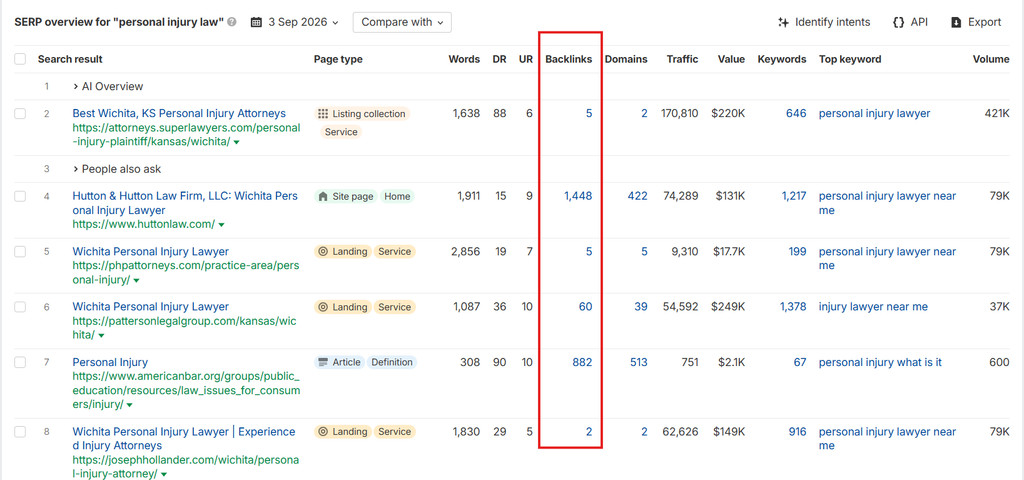
Take an example above. 3 websites in the top 10 has less than 5 links, and when you’ll check these links, the authority is low. So in this, you can rank in top 10 without spending huge on links.
However, If the site has indexation problems, fix those first. Links to a page Google can’t index is similar to build a runway for a plane that can’t fly.
And if a firm has forty city pages with the same three paragraphs and a swapped place name, more links will not help. The pages are the problem, and no number of links fixes a page.
It takes an hour to check and fix all these but occasionally save a firm a year of spend.
Which page the link should point at?
This is one of the few decisions in link building that a firm can get badly wrong on its own.
Practice area pages are usually the answer for a firm competing on service terms. They are also the hardest pages to earn links to, because no journalist has ever wanted to link to a page headed “Car Accident Lawyer in Phoenix.”
That difficulty is the actual problem, and there is a way around it. Build the thing worth linking to somewhere else on the site, then route the authority internally. A firm with real data about local court timelines, a plain-English guide to a statute that changed this year, or a genuinely useful calculator has something a publication will link to. Those pages then link to the practice area pages that need the help.
City pages need local links from local sources. They are the easiest honest links available to a firm. Chambers, sponsorships, local press, community organisations. A firm with genuine local involvement usually already has three or four of these and has never claimed them.
The homepage collects links you did not aim anywhere. That is fine. Do not build a campaign around it.
What I will not sell a Law firm?
I have turned down legal work more than once, and it is usually one of these.
Award badges from schemes that sell the award. Some legal awards are genuine. Some are a payment in exchange for a badge and a listing, and the badge goes on the firm’s site implying an assessment that never happened. That is a bar question before it is ever an SEO question, and I would rather not be the person who put it there.
Publishers who want paying for a link with no article behind it. This one comes up regularly and the answer is always no. If a site owner will run a paragraph they have not read to hold a link they were paid for, they will do the same for anyone who pays. Your firm’s link then sits alongside everyone else who paid, which is what makes the placement worthless.
Anything a firm would have to explain twice. If I imagine a client or a bar association asking what this is, and the answer needs paragraphs, it is not worth the placement.
Let me give you an example of few placements that I’ve done and the one I’ve rejected.
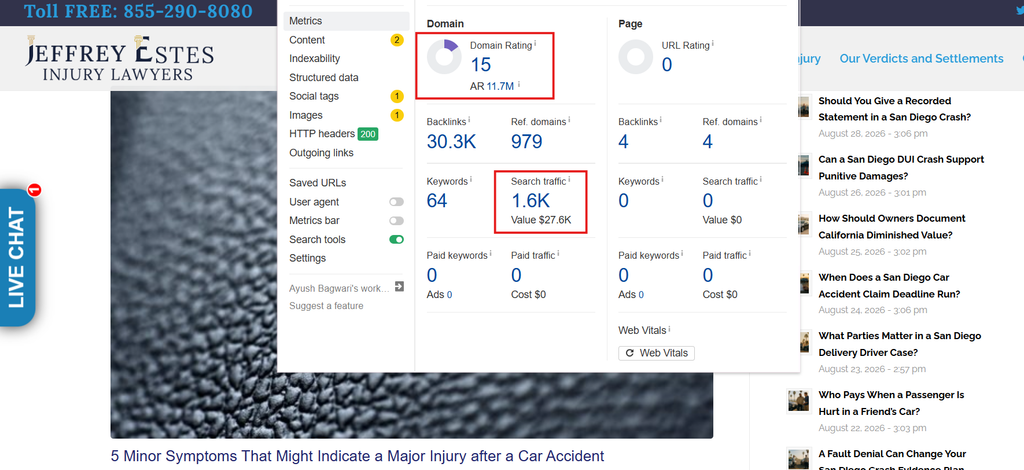
Look at the above image. I’ve placed a link of our client on the above website. Now check the stats:
- DR: 15
- Traffic: 1.6k
- Traffic value: $27.6k
Most agencies would have disqualified this site due to low DR, but we selected this. The reason is simple. it’s not a publishing website. It’s a site of competitor managed by real lawyers. So whatever content site is publishing, comes from people with authority and real credibility.
DR is just a vanity metric, and when you got these kinda links, the impact is far more better than the general sites with higher DR.
Now let’s take an example of another site that I’ll always disqualified:
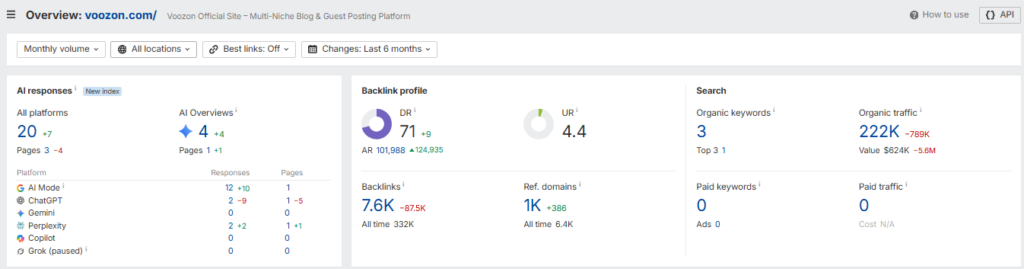
The above site has DR 71, Traffic 222k, traffic value 3, but the organic keywords are just 3. So this link isn’t suitable for law firms, and I’ll never use these kinda sites for any of our client.
What it looks like when Link Building for Lawyers Work?
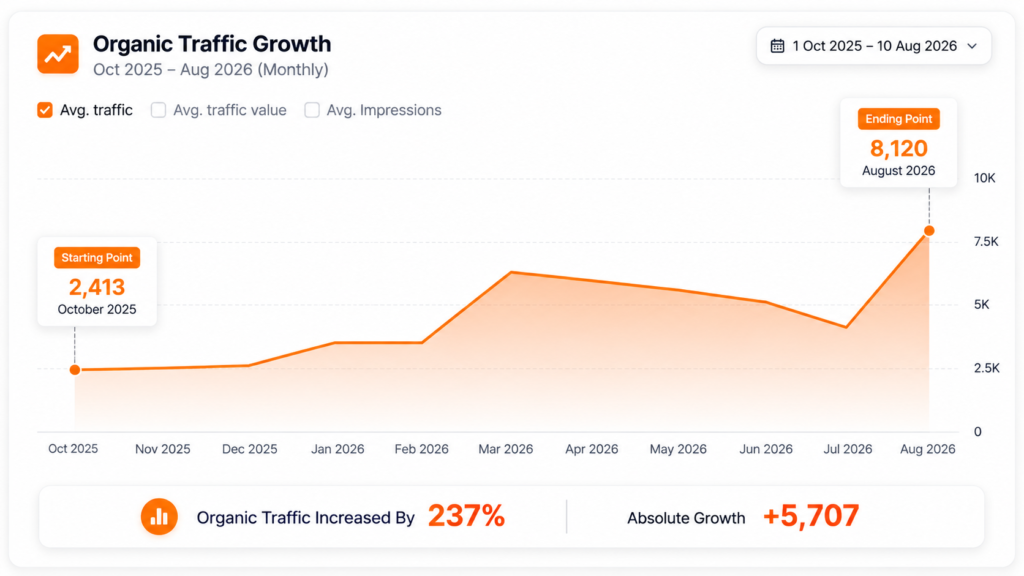
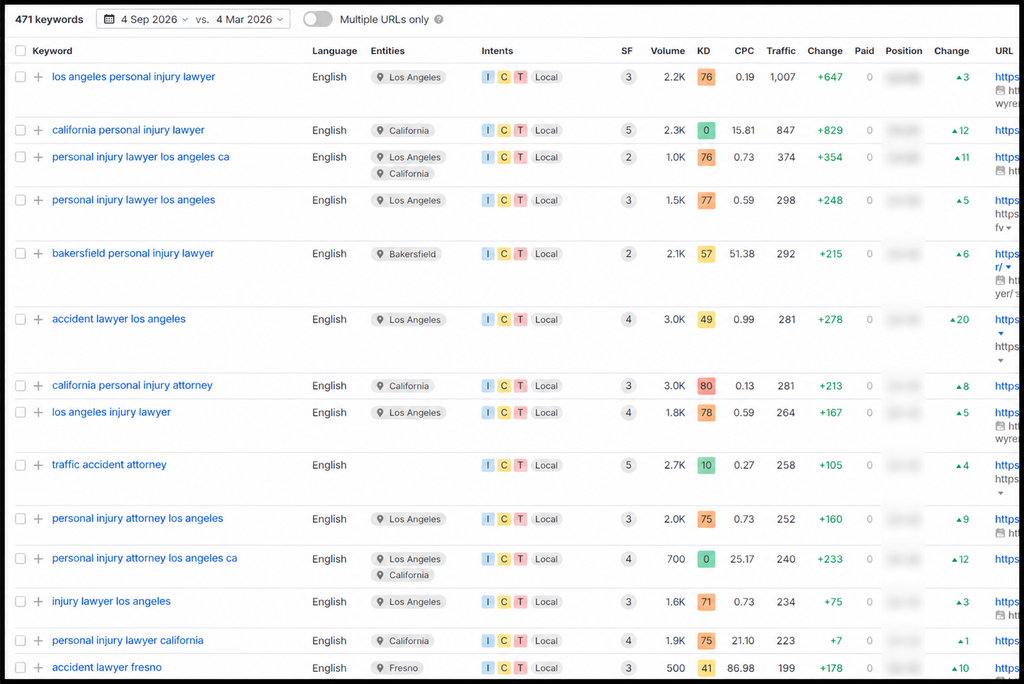
When links are placed naturally on the relevant authority law sites, results came automatically. Rankings improved, and law firms started getting new enquiries everyday for thier targeted keywords. We’ve worked with several law firms, and everytime, we’ve got something for them. In this campaign of a las vegas law firm, we’ve improved thier rankings for several money keywords like, injury lawyer las vegas, personal injury lawyers las vegas, and accident lawyers in las vegas.
You can read the full case study of las vegas law firm on our case studies page.
What Should I ask Before Hiring a Link Building Agency for My Law Firm?
If I run a law firm, these are the questions I’d ask to my link building partners before hirng them.
1. How do you judge whether a site is worth approaching?
You want a filter with thresholds attached, and you want traffic in the answer alongside the authority scores. Domain rating and its equivalents measure a backlink profile and nothing else. A supplier treating that number as a quality score is telling you they have not looked past it.
2. What kills a site for you?
A specialist can answer this instantly and specifically. Traffic that does not match the authority number. Outbound links across unrelated industries. No editorial history in the subject area. Vagueness here means the vetting is not happening.
3. Can you show me five legal placements from the last ninety days.
Not a client list, the actual links. Recent, because a supplier’s site list changes, and legal specifically, because placing in software is not evidence of being able to place in law.
What happens when a publisher wants paying for a link with no article behind it? Anyone doing this properly has already met this situation and has a policy. Someone who has never thought about it is telling you they take whatever is offered.
4. Have you read my state’s advertising rules?
The honest answer from most agencies is no. That is not disqualifying by itself. Refusing to go and read them is.
5. What happens when a link comes down?
Ask about the replacement window and get it in writing. Links come down. A supplier with no answer has not been doing this long.
If you want a second opinion on a proposal you are already holding, send me the publisher list. I will tell you which sites I would reject and why, and you can take that to whoever sent it. Book a call with me if it is easier to talk it through.
Final Thoughts
Take the proposal in front of you and find the line that says what happens between the day you pay and the day a link appears. If it is not there, ask. The answer will tell you which of the three transactions you are actually being sold, and that is the only thing you need to know.
Frequently Asked Questions
How many backlinks does a law firm need?
There is no number. Pull the top five results for the term you want and count referring domains to those specific pages, not to the whole domain. That gives you a target built from your actual competition. A number quoted in a blog post is not one.
Are legal directories worth it?
The free ones are worth claiming for consistency and discovery. The paid ones are an advertising decision, and should be judged on whether they send you clients, not on the link. Several send neither.
Is it against bar rules to hire a link building agency?
ABA Model Rule 7.2(b) expressly permits a lawyer to pay “the reasonable costs of advertisements or communications permitted by this Rule.” Your state’s version is what governs you, and states vary. Read yours.
Will buying links get my firm penalised by Google?
Google’s spam policies cover links bought or sold for ranking purposes. The practical question is whether the content around the link exists for its own reasons. If deleting the link would leave a piece that still makes sense, you are in different territory than if it would leave a sentence with no purpose.
How long before link building shows results?
Months. Longer in legal than in most verticals, because the pages you are competing with are strong. Anyone promising movement in thirty days is describing something other than what they will deliver.
Should links point to my homepage or my practice area pages?
Practice area pages for service terms, city pages for local terms. Build linkable assets elsewhere on the site and route the authority internally, because publications will not link to a commercial service page.
What is the difference between local and statewide link building for a firm?
Local work leans on chambers, sponsorships, community organisations and regional press. Those links are easier to earn honestly. Statewide work needs legal trade publications and larger press, which are harder and slower.
Can I do this in-house?
The directory and local work, yes. A firm with genuine community involvement usually has links it could claim and has not. Publisher outreach at any volume is a full-time job, which is why most firms who try it in-house stop after two months.
Does my practice area change the approach?
Yes. Personal injury is the most competitive legal vertical in search and needs volume. Estate planning and immigration often rank on a fraction of it. Check your own competition before assuming you need what a PI firm needs.
What should the contract say?
What counts as a delivered placement. What happens when a link drops, including how long they have to replace it. Reporting format and cadence. The minimum term, and who owns the placements if you walk away.