
OUTREACHEMPRESS
OUTREACHEMPRESS
★★★★★ 4.8/5 on Clutch
Book a Strategy Call
Home / Blog / Link Building
Link Building 20 min read

24 Claude Cowork Prompts for Link Building (The System We Use)

Ayush Bagwari
CEO & Founder
Published 27 September 2026
Claude Cowork Prompts for link building

Almost every Claude SEO prompt list you’ll find covers the same ground. Keyword research, content briefs, title tags, maybe a Google Business Profile audit. All useful. None of it gets another website to link to you.

Links are still the part of SEO that takes the most hours and has the least automation. So that’s where we pointed Claude.

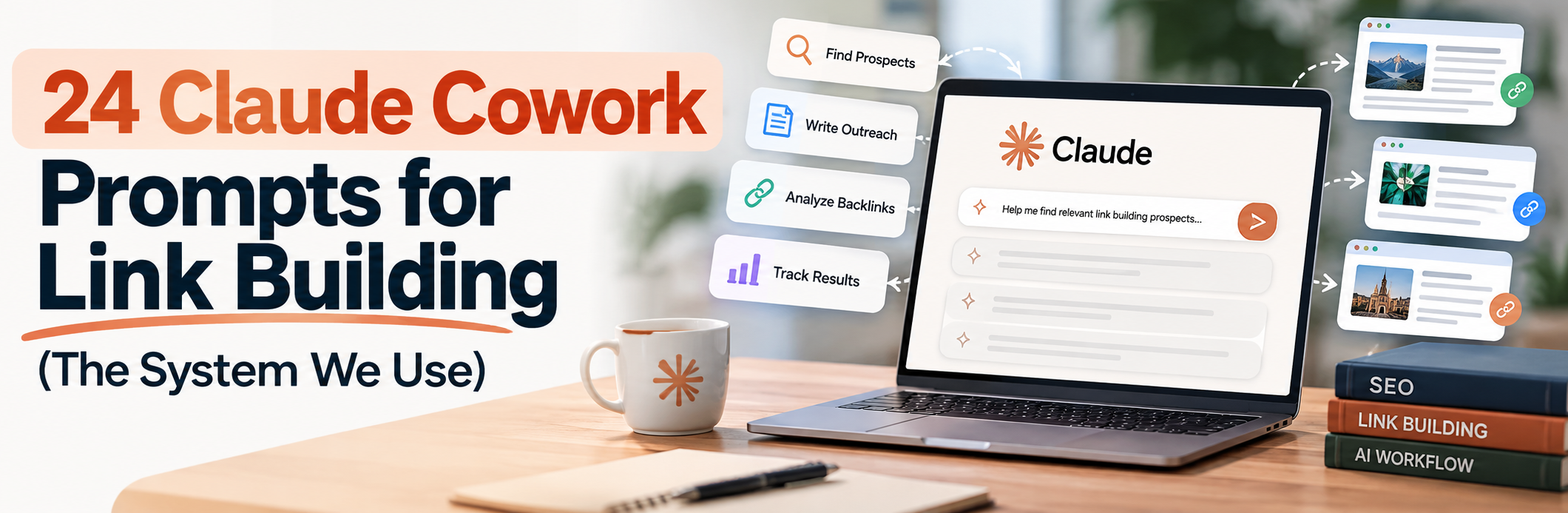
What follows is the prompt system we use at Outreach Empress to run link building campaigns inside Claude Cowork. There are 24 prompts, split by stage of a campaign, from “which of our pages even deserve links” through to “did the link actually go live.” Each one has a short note on why it’s built the way it is.

Take them. Change the brackets. Use them on your own site.

Why Cowork and not a normal Claude chat?

You can paste every prompt here into a regular Claude chat and get something useful. Cowork is better for outreach for one reason: it can do the legwork between prompts.

In a chat, you visit 60 prospect sites yourself and paste what you find. In Cowork, Claude opens Chrome, visits the 60 sites, reads the folder where you keep your prospect list, and writes its findings back to a spreadsheet. You check its work instead of doing it.

That changes which prompts are worth writing. A lot of the prompts below say “open Chrome and visit each URL.” In a plain chat, you’d drop that line and paste the page content yourself.

Set up the outreach folder first

Every prompt in this system reads from one folder. Build it once, and you’ll never type your company description into Claude again.

Here’s the layout we use:

outreach/ 00-brief.md who we are, what we sell, who we want links from voice/ 3-5 real outreach emails that got replies assets.csv our pages worth linking to: URL, what it is, why someone would cite it competitors.csv 3-5 competitor domains and their strongest pages do-not-contact.csv domains and people we never pitch (clients, past complaints, link sellers) prospects.csv the working list, filled in by the prompts below sent-log.csv date, prospect, template used, reply (yes/no), link live (yes/no) exports/ raw backlink and Search Console exports

The voice folder matters most. Claude copies tone from examples far better than from descriptions. “Friendly but direct” means nothing to it. Three emails that actually got replies tell it everything.

The do-not-contact list is there because Cowork is fast. Without it, Claude will happily pitch your biggest client’s blog.

The setup prompt

Run this at the start of every Cowork session.

Read everything in the outreach/ folder before we start. This is a link building campaign for [website]. How I want you to work: – Never send an email, submit a form or post anything. You draft, I send. – Before adding any prospect, check do-not-contact.csv. If they’re on it, skip them and say so. – When you write outreach, match the tone of the emails in voice/. Same length, same level of formality. – Never invent a fact about a prospect. If you haven’t read it on their site, don’t put it in an email. – If a site blocks you, is behind a login, or won’t load, mark it “couldn’t check” and move on. Don’t guess what’s on it. – Write all findings to prospects.csv. Keep one row per domain. Confirm you’ve read the folder by telling me our three strongest link assets from assets.csv and why you picked them.

The last line is a check. If Claude names the wrong pages, the brief is unclear, and every prompt after this will inherit the problem.

Part 1: decide what you’re building links to (prompts 1-4)

Most campaigns fail before the first email goes out, because they’re pitching a page nobody has a reason to cite. Start here.

1. The “would anyone cite this?” test

Open each URL in assets.csv in Chrome. For each page, answer as a skeptical editor at a site in our niche would: 1. If I were writing an article on this topic, what exact sentence would I write that links here? Write the sentence. 2. Does the page have anything a writer can’t get elsewhere: original data, a tool, a template, a strong opinion from someone with credentials? 3. Score it 1-5 for linkability. Anything that scores 1 or 2, tell me in one line what would have to be added to get it to a 4. Update assets.csv with a new column “linkability”.

Why it works: forcing Claude to write the actual sentence that would link to your page cuts through the hope. If it can’t write a believable one, an editor won’t either. Service pages almost always score low here, which is normal. You link-build to assets, then pass that authority to service pages through internal links.

2. Anchor text health check

Open the backlink export for our domain in exports/. Group every referring domain’s anchor text into: – branded (our company name or URL) – exact match (the exact keyword the target page wants to rank for) – partial match – generic (“click here”, “this site”, “source”) – image/empty Show me the percentages. Then compare them with the same breakdown for [competitor 1] and [competitor 2] from their exports. If our exact-match share is noticeably above theirs, list the target pages where it’s concentrated. That’s where our next links should use branded or generic anchors.

Why it works: over-optimised anchors are one of the easier things for Google to spot, and one of the easiest to accidentally create when you’re asking for links. Knowing your ratio before a campaign tells you what anchors to request. The competitor comparison stops you from chasing a “safe” number you read on a forum. Your niche’s real ratio is the one that matters. If you want a second opinion on your profile, we also run a free backlink audit.

3. Link velocity vs competitors

Using the referring domain exports in exports/ (they include a “first seen” date), count new referring domains per month for the last 12 months for us and for each competitor in competitors.csv. Give me a month-by-month table, then answer: – Which competitor is gaining links fastest right now? – Did any competitor get a sudden spike? If so, open 5 of the links from that month in Chrome and tell me what caused it (a PR campaign, a data study, a directory blast, something else). – How many new referring domains a month would we need just to keep pace with the median competitor?

Why it works: the total link count tells you history. The monthly rate tells you who’s winning now. The spike investigation is the useful bit. When a competitor jumps from 4 new domains a month to 40, there’s usually one campaign behind it, and you can learn from it.

4. Pick this quarter’s target pages

Open the Search Console export in exports/. Find pages where we rank in positions 5-20 for a query with commercial intent and at least [X] impressions a month. For each one, check: – how many internal links point to it from our own site (crawl our site in Chrome, starting from the homepage, max 200 pages) – how many referring domains it has (from the backlink export) Give me the 5 pages where external links would help most. If a page has fewer than 3 internal links, flag it: fix internal linking before spending outreach time on it.

Why it works: pages sitting just off page 1 are the ones where a handful of links changes revenue. The internal link check is there because we see it constantly. People spend weeks earning links to a page that their own site links to once, from the footer.

Part 2: find and qualify prospects (prompts 5-10)

5. Build a prospect list from Google search operators

Open Chrome and run these Google searches one at a time. Go through the first 3 pages of results for each: – [topic] intitle:resources – [topic] inurl:links – [topic] “useful links” – [topic] “further reading” – [topic] “guest post by” – [topic] “contributor” For every result that’s a real editorial site (not a directory, marketplace, forum or social platform), add a row to prospects.csv with: domain, the URL you found, which search found it, and the page type (resource page / guest post / contributor program). Skip anything already in prospects.csv or do-not-contact.csv. Stop after 80 new rows or when searches stop returning new sites.

Why it works: search operators are old-school, and they still find sites that SEO tools miss, especially small niche blogs with low domain ratings but real readers. Recording which search found each site shows you, after a few campaigns, which operators are worth running for your niche.

6. Qualify every prospect before you pitch it

This is the prompt that saves the most time.

For each row in prospects.csv without a “qualified” value, open the site in Chrome and check: 1. Date of the most recent post. Anything older than 6 months: mark “inactive”. 2. Does the site link out to other sites in its articles? Open 2 recent posts and look. No outbound links at all: mark “doesn’t link”. 3. Does it sell posts? Look for “write for us” pages with prices, “sponsored post” rates, or a pattern of every recent article having a commercial link in paragraph 2. If so: mark “link seller”. 4. Topic fit: in one line, how close is this site to what we sell? 5. Is there a real named author or editor anywhere on the site? Mark each row “qualified: yes / no” with the reason. Be strict. I’d rather pitch 20 good sites than 80 average ones.

Why it works: most outreach lists are about half dead sites, link sellers and sites that never link out. Pitching them wastes sending volume and hurts your domain’s email reputation. The “every recent article has a commercial link in paragraph 2” check catches link sellers who don’t advertise it.

7. Find the right person to email

For each qualified prospect, find the person who decides what gets published or linked. Check in this order: author bio on the page we’d want a link from, the about/team page, the contact page, the “write for us” page. Record: name, role, and where you found them. If you find an email address published on the site, record it. If you don’t, write “not published”. Don’t guess a format like firstname@domain. If the only option is a generic contact form or info@ address, mark it “generic contact” so I can decide whether it’s worth it.

Why it works: a pitch to the person who wrote the article you want a link from gets read. A pitch to info@ goes to whoever checks the shared inbox, if anyone does. The instruction not to guess email formats matters. Guessed addresses bounce, and bounces damage your sender reputation fast.

8. Unlinked brand mentions

Open Chrome and search Google for: – “[our brand]” -site:[our domain] – “[founder name]” “[our brand]” -site:[our domain] – “[our product name]” -site:[our domain] Go through the first 5 pages of results. For every page that mentions us, check whether it links to us. If it doesn’t, add it to prospects.csv as type “unlinked mention”, with the exact sentence that mentions us. Skip social media, our own profiles on directories, and job boards.

Why it works: these are the easiest links you’ll ever get. The site already decided you were worth mentioning. The ask is just “could you make that a link so readers can find us?” Recording the exact sentence lets the email quote it back to them.

9. Broken link prospecting on resource pages

For every prospect in prospects.csv with page type “resource page”, open the page and check each outbound link in the main content. Record any that return an error, redirect to a homepage, or go to a parked domain. For each broken link, write down: the dead URL, its anchor text, and what the page probably was (use the URL, the anchor and, if possible, the Wayback Machine at web.archive.org). Then check assets.csv. If one of our pages would be a genuine replacement, note which one. If none is, leave it blank. A weak replacement pitch is worse than none.

Why it works: telling someone their page has a broken link is doing them a favour before you ask for one. The Wayback Machine check tells you what the dead page actually covered, so you only offer a replacement when it really fits.

10. Journalists who already covered this topic

Open Chrome and search Google News for these, covering the last 12 months: – [competitor name] study – [competitor name] survey – [topic] “according to a report” – [topic] “new data” For each article, record the publication, the journalist’s name, the article URL, and which study or data it cited. Then open the journalist’s author page on that publication and list their last 5 article headlines. Add them to a new tab in prospects.csv called “journalists”. Don’t include anyone whose last 5 articles are off-topic.

Why it works: journalists who wrote about a competitor’s data are the best digital PR targets there are. They’ve shown they cover this topic and that they cite data. Checking their last 5 headlines stops you pitching someone who’s since moved to another beat.

Part 3: write the pitches (prompts 11-16)

11. Research note before every email

For each qualified prospect with a contact name, open their 3 most recent articles and write a research note in prospects.csv: – one specific point they made in one of the articles (paraphrase it, don’t quote more than 10 words) – one gap or question the article left open that we could help with – which of our assets fits, if any If nothing on their site connects to what we offer, say so and mark the prospect “no angle”. Don’t force it.

Why it works: this is the difference between outreach that gets replies and outreach that gets marked as spam. Splitting research from writing also means you can review the notes before any email exists. If the note is weak, the email will be too, and you’ve caught it cheaply.

12. Guest post pitch that doesn’t repeat their archive

Write a guest post pitch for [prospect name] at [domain], using the research note in prospects.csv. Before suggesting topics, search their site in Chrome (site:[domain] [topic]) and make sure none of the ideas duplicate something they’ve already published. Pitch 3 topics. Each gets a working title and one sentence on the angle. The topics should suit their readers first and give us a natural reason to cite [asset] second. Rules: – match the length and tone of the emails in voice/ – open with the specific point from the research note, not a compliment – no mention of SEO, backlinks, DA or DR – subject line under 45 characters – end with a question they can answer in one word

Why it works: the archive search stops the most common guest pitch failure, suggesting an article the editor published last year. “Suit their readers first” is intentional. Editors can spot a topic invented to carry a link.

13. Resource page pitch

Write a short email to [name] about their resource page at [URL]. Point to the exact section of their page where [our asset] would fit, and explain in one sentence what it covers that the other links in that section don’t. Under 90 words. Match voice/.

Why it works: a resource page owner cares about one thing: whether your link makes their page more useful. Naming the exact section shows you actually read the page, and it saves them from having to work out where it would go.

14. Broken link pitch

Write an email to [name] telling them the link to [dead URL] on [their page] is broken (anchor text: “[anchor]”). Lead with the broken link. Mention [our replacement page] second, as one option. Under 80 words. Match voice/.

Why it works: the order matters. Lead with the useful information and the email reads as a favour. Lead with your page and it reads as a pitch with a pretext.

15. Two follow-ups, then stop

Here’s the email I sent to [prospect] [X] days ago with no reply: [paste, or read from sent-log.csv] Write 2 follow-ups: – Follow-up 1 (send day 5): add one new thing: a different topic idea, a new stat or a smaller ask. Under 60 words. – Follow-up 2 (send day 12): a short close that makes “no thanks” an easy reply. Under 40 words. Don’t use “just bumping this”, “circling back”, “following up on my last email” or “did you get a chance to”.

Why it works: in our experience, a lot of replies come from the first follow-up, and very few come after the second. A third follow-up mostly gets you spam reports. Giving each follow-up a new reason to reply is what separates it from a nudge.

16. Subject line test set

Look at sent-log.csv. Group sent emails by subject line style (question, specific reference to their article, plain description, name-drop) and calculate the reply rate for each group. Only report groups with at least 15 emails sent. Then write 5 subject lines for the next batch using the best-performing style, for this pitch: [paste pitch].

Why it works: after 100 or so sends, your own data is better than any subject line advice on the internet. The 15-email minimum stops Claude from declaring a winner based on three replies.

Part 4: replies, content and live links (prompts 17-20)

17. Reply triage

Here are the replies from this week’s outreach: [paste, or read from exports/replies] Sort each one into: – yes (they want the article / will add the link) – interested but has questions – wants payment – not now / not interested – auto-reply or wrong person (note who to try instead if they named someone) Draft a response for every reply in the first three groups. Update sent-log.csv with the outcome.

Why it works: on a big campaign, replies pile up and good ones go cold. Sorting them turns an inbox into a to-do list. The “wrong person” group often has a name in it. “I’ve moved on, try Sarah” is a warm introduction.

18. The “what’s your price?” reply

[Prospect] replied asking for $[amount] to publish our article. We don’t pay for links. Write a friendly reply that declines payment and offers something else instead: [what we can offer, e.g. promoting the article to our newsletter of X readers, citing them in a future study, a useful original data point for their article]. Under 80 words. Don’t lecture them about Google’s guidelines, and don’t make them feel bad for asking.

Why it works: plenty of site owners ask for money by default and will publish for free if the content is good and the alternative offer is real. Lecturing them about link schemes ends the conversation. A good offer keeps it going.

19. Write the guest post to their style

[Site] accepted our pitch for “[title]”. Open their guidelines page at [URL] and 3 of their recent articles in Chrome. Write down their style rules: typical word count, heading style, whether they use first person, how they format lists, how many external links they tend to include, whether they use images. Then write an outline for our article that follows those rules. I’ll write or edit the draft myself. Mark the one place where a link to [our asset] would help the reader, and write the sentence around it.

Why it works: articles that read like the site’s own content get published without edits and stay published. The instruction to find one natural spot for the link is deliberate. Editors remove links that look forced, and a single well-placed link is worth more than two awkward ones.

20. Confirm the link is live and counts

For every row in sent-log.csv marked “published” in the last 60 days, open the URL in Chrome and check: – is our link still on the page? – the exact anchor text – rel attribute: dofollow, nofollow, sponsored or ugc – is the page indexable (no noindex tag, not blocked in robots.txt)? – is the page in Google? (search site:[exact URL]) Update sent-log.csv. Flag anything where the link has disappeared or changed to nofollow since it went live.

Why it works: links disappear more often than people expect. Sites redesign, editors clean up, pages get noindexed. A link you never check could have vanished weeks ago. Checking indexation is the step people skip. A link on a page Google hasn’t indexed does nothing.

Part 5: digital PR (prompts 21-23)

21. Find the story in your own data

Here’s data we have access to: [describe it: customer survey results, anonymised usage data, pricing data across X cities, etc. Paste or point to the file.] Find the 5 findings a journalist would find surprising or useful. For each: – the finding in one sentence with the number in it – a headline a newspaper would run (not a marketing blog) – which publications from the “journalists” tab in prospects.csv would care, and why Rank them. Flag any finding where the sample size is too small to defend if a journalist asks.

Why it works: this is how most digital PR campaigns start. Most companies are sitting on data that would make a news story and don’t know it. The sample size flag protects you. A journalist who spots weak methodology won’t cover you, and some will write about the weak methodology instead.

22. Newsjacking with a real point of view

Here’s a story in the news today: [headline, URL, 2-line summary] Our spokesperson is [name, role, relevant experience]. Suggest 4 angles where they could add something the story doesn’t already have. For each, write the quote they’d give: 2 sentences, specific, willing to take a side. Then find 3 journalists in prospects.csv who cover this topic and say which angle fits each.

Why it works: speed and opinion win newsjacking. A quote that says “this is an interesting development and businesses should pay attention” never gets used. A quote that says the policy is wrong and why gets used.

23. Answer journalist requests fast

A journalist posted this request on [Qwoted / Featured / Source of Sources / social media]: [paste request] Our expert is [name, title, experience]. Relevant examples or numbers we can share: [paste]. Write a response under 150 words that answers exactly what they asked. Put the most quotable sentence first. End with a one-line bio. If the request isn’t a good fit for our expert, tell me instead of writing it.

Why it works: journalists get dozens of responses and read the first line of each. Putting the quote first is the whole trick. The “tell me if it’s not a fit” line stops you from sending weak answers that train journalists to skip your name.

Part 6: reporting (prompt 24)

24. Monthly link report that shows what’s working

Using sent-log.csv, prospects.csv and a fresh backlink export in exports/, build this month’s link building report: 1. Links won this month: URL, DR, traffic, anchor, target page, dofollow or not 2. Reply rate and win rate, broken down by prospect type (guest post, resource page, broken link, unlinked mention, PR) 3. Which template in voice/ or which subject line style performed best 4. Movement in rankings for the target pages from prompt 4 (from the Search Console export) 5. What we’ll do differently next month, in 3 bullet points or fewer Keep it to one page. Write it for someone who doesn’t do SEO.

Why it works: the breakdown by prospect type is what makes this more than a vanity report. After two or three months it tells you, for your niche, whether broken link outreach beats guest posts, and you can move your hours to whatever wins.

How to roll this out: your first 4 weeks

Don’t run all 24 prompts on day one. Here’s the order we’d use for a first campaign.

Week 1 is setup and targeting. Build the folder, run the setup prompt, then prompts 1 to 4. By Friday you know which pages you’re building links to and roughly how many links you need.

Week 2 is prospecting. Run prompts 5 to 10, then spend an afternoon reviewing prospects.csv yourself. Delete anything that feels wrong even if Claude marked it qualified. You should end the week with 40 to 60 prospects you’d be happy to pitch.

Week 3 is outreach. Run prompt 11 on the whole list, review the research notes, then prompts 12 to 14 for the drafts. Send in batches of 10 to 15 a day, not all at once.

Week 4 is follow-ups and replies. Prompts 15, 17 and 18 as replies come in. Prompt 19 for any accepted guest posts.

After that, run prompt 20 every two weeks and prompt 24 at the end of each month. Prompts 21 to 23 run whenever you have data or a news story worth reacting to.

Where this goes wrong

We’ve run this system for long enough to know its failure points.

Claude will occasionally invent something. Even with the “never invent a fact” rule, it sometimes paraphrases an article’s headline as if it had read the whole piece. Read every research note before any email goes out. This is the one step you can’t hand over.

Sites block Cowork. Plenty of sites use bot protection, and Claude will hit a verification wall. That’s why the setup prompt tells it to mark those “couldn’t check.” Visit them yourself or drop them.

It’s too polite. Left alone, Claude’s outreach sounds like a customer service team. The voice/ folder fixes most of this. If emails still come out stiff, add a line to the setup prompt: “Write like a person emailing a peer, not a company emailing a customer.”

It can’t judge quality the way you can. Claude can check whether a site posts regularly and links out. It can’t tell you whether a link from that site would make you proud or embarrassed. You still decide that.

Frequently asked questions

Can Claude Cowork do link building on its own?

It can do most of the research and drafting: finding prospects, qualifying them, writing emails, checking whether links went live. It can’t build relationships or judge whether a site is one your brand should appear on, and you should never let it send emails without you reading them. Think of it as a very fast research assistant.

Do these prompts work in a normal Claude chat?

Yes. Remove the “open Chrome and visit” instructions and paste the page content or data into the chat yourself. It’s slower, but the prompts work the same way.

Do these prompts work with ChatGPT or Gemini?

Mostly. The prompts are plain instructions, so any capable model can follow them. The browsing and folder steps depend on the tool you use having those abilities.

Is AI-assisted outreach against Google’s guidelines?

Google’s guidelines are about the links, not how you found the prospect or drafted the email. Earning editorial links by offering good content is fine. Paying for links, or trading them at scale, is against the guidelines whether a person or an AI arranged it. That’s why prompt 18 exists.

How many links can I expect from this?

It depends too much on your niche, your assets and how good your pitches are to give a useful number. Track your own reply and win rates in sent-log.csv. After 100 sends you’ll have a better estimate than anyone could give you from outside.

Want us to run it for you?

This is the system. Running it well still takes hours every week, plus judgment about which sites are worth your name.

That’s what we do at Outreach Empress. If you’d rather hand the whole campaign over, from prospecting to live links, see our blogger outreach service or talk to us and we’ll show you what it would look like for your site.

Written by

Ayush Bagwari

CEO & Founder

Ayush Bagwari is the founder of Outreach Empress. He started as an outreach specialist and now runs a link building agency that has placed 50,000+ contextual links for 100+ brands and agencies since 2019. He works the verticals most teams avoid: Cannabis, Kratom, iGaming, Crypto, SaaS, and treats Google rankings and AI citations as the same job. If a backlink won’t move a ranking, his team doesn’t build it.

All posts

Send us the list you're about to buy from

We'll run the five checks on it and tell you which sites we'd reject, whether or not you work with us.

Book a Strategy Call →
★★★★★ 4.8/5 on Clutch 2,965 links placed